Author2Author: Jessica Abel & Alison Bechdel
Perhaps you noticed yesterday’s enthusiastic NYTBR review of La Perdida, the new graphic novel by Jessica Abel. It also got a starred review from Publishers Weekly, as did Fun Home, the graphic memoir by veteran cartoonist Alison Bechdel. The ways that these two women are taking the comics medium and using it as a vehicle for personal expression convinced me that getting them talking to each other would yield a lot of insights for readers…and as their conversation unfolds, I hope you’ll believe I was right.
 Alison Bechdel: La Perdida originally came out in serialized form over a period of four years. As a comic strip artist, I’m really interested in the aesthetics of serial publication, so I’m wondering things like, how tightly did you have the whole story mapped out before you started drawing? How much did you make up as you went along? Did you paint yourself into any interesting corners? Was serial publication an economic necessity? Did reader response influence the development of the plot at all? How did the constraint of the serial volumes, lengthwise, effect the structure of your larger dramatic arc? And finally, were there any major plot changes between the serialized version and the graphic novel?
Jessica Abel: One thing I’ve figured out as I learn to teach art students to make comics is that my own method of making comics is at least unteachable, if not just plain unadvisable. There’s a huge proportion of improv that goes into it, even in the short stories, though of course, they’re really short.
Basically, I started with a vague idea for a scene (the hallucinatory scene at the end of chapter one). As I thought about who might be having that vision, and why, I came up with Carla, then Harry. I spent a long time developing and thinking about the characters and what bound them together, which led me to come up with a lot of the major plot points. I have to admit, how I got from that first idea to the whole arc is sort of lost in the mists of time. But as far as I remember, I worked out the whole story arc, then sat down and started writing chapter one. I probably started drawing it before I even finished writing it, knowing me. There were a number of directions I intended to follow to resolve the events at the end (no spoilers!) that I ended up rejecting as too byzantine or just not necessary. For example, the scene in chapter one where Carla and Harry go to meet a journalist—I had the idea that she would be instrumental later on, that the drama would somehow play itself out in the newspaper as well. But in the end that idea was just too unwieldy, and I simply left that early scene in to give some sense on context. It’s one of the few based on actual events; I met a journalist like her early in my time in Mexico, and she said similar things about living in Mexico. A lot more of them, actually.
But anyway, I dived right in before I’d nailed down all the details of the story, in order to motivate myself to move forward on the book. The thing this method had in common with my earlier short stories was the fact that I had to fit the chapter chunks into multiples of 8 pages, due to the way books are printed. In fact, it’s better/easier to print books in multiples of 16 pages, which is what I did in this case. So all along, as I’m writing, then thumbnailing the pages, then penciling and inking, I’m thinking: this has got to come out at 44 pages (to account for the title page, indicia, etc.). I’m massaging, projecting ahead, trying to shorten or lengthen…OK, seriously? I never have to lengthen. Only shorten. But anyway, it’s a strange process that I trained myself into early on, a version of what you have to do with the space for your strip, but of course a lot longer, so a lot more can happen (i.e. go wrong) in the middle. Though maybe that’s presumptuous of me. I think working in strip form—such tiny chunks of narrative—must be incredibly demanding.
Overall, I fit chapters one through four into 44- or 45-page chunks, but I still missed my length by about 60 pages (all of chapter five). I expected to finish in four 48-page books. So I obviously didn’t know what I was doing too clearly.
As to your more technical questions: serializing was not really an economic decision. Of course I was happy to make a bit of money, but it’s a pretty small bit. It was an artistic necessity. I know myself too well. I would never have completed the book if I tried to do it all myself at home, with no intermittent deadlines. That said, I think the book would have been better, and certainly somewhat different, if I’d planned it more fully at the beginning and completed it all at once, without serializing. Not that I think it’s no good, but simply that it could have been better, tighter, more well-thought-out. But comics are punishing to make that way, as I’m sure you know. And editing is so extremely painful. You slave over the pages, and in order to change anything you have to rework, redraw, cut things up, sometimes just start over. It’s such a high price.
Still, I did do a lot of editing. Mostly small stuff, though, like changing a facial expression or tweaking dialogue. Especially in part one, since the story was still so unformed at that point. I didn’t change anything based on reader reactions, except when those readers were my editors: especially my husband Matt, my consultant/translator Ernesto, and my agent Tanya. They all had valuable stuff to say once they’d read early parts of the story.
If I ever attempt another graphic novel (not a given—I’m thinking short stories look awfully good around now), I think I’ll still want to serialize, but only after I’ve done a lot more writing. I would say “and a lot more thumbnails and drawing”, but I know myself too well to think I’ve changed that much.
How did you go about structuring Fun Home? I was deeply impressed by the waves of revelation, the way you’d, for example, return to the scene of your father’s death over and over, from different angles, asking different questions. You reject mystery early on, telling us the major “plot points” without fanfare: your coming out, your father’s secret life, his early death. But then you go away and return over and over, teasing out new levels and new insight. Though the voice is insistently reasonable, the repetitions start to make us feel the obsession, the possibility that this is a spot where you (or “you”) remain stuck, trying every possible angle to push out and escape that moment long ago. As the same scenes played out over and over in slightly different ways, I was forcibly struck with a sense of the completeness of your view of the structure of the book—and perhaps that’s mistaken, but it really felt as if you had looked at the whole of the work as a kind of poetic structure, perhaps, or some other meta-form.
Is this meta-form or poetic structure deliberate, or did you simply let the book evolve as you worked? Did you have the whole thing thumbnailed and planned before starting the art? What is your process like? Was this a radically different experience from making a strip? Could you, possibly, have told this story in weekly installments? What effect did your history of thinking in weekly bits have on the way you worked on this book?
Alison Bechdel: I laughed when you said you consider your own method unteachable if not inadvisable, because I feel pretty much the same way about mine. In fact, referring to the way I approached this project as a “method” at all is a wild exaggeration. Though toward the end, I did start to get a handle on what I was doing.
I spent a very long time on this book—seven years from start to finish. I started by just writing. I had a bunch of core memories that I knew instinctively were a part of the narrative, but I didn’t know how or where they fit. I realized pretty early on that a simple chronological structure wasn’t going to work. I had too many things that I wanted to say about each event. I had this constellation of ideas surrounding my father’s death that I wanted to investigate—my parents as fictional characters, creativity as a form of compulsion, how my life and my father’s life fit into recent gay and lesbian social history, things like that—so it became clear that my organization would need to be thematic. The linear story turned into a spiral, circling back over the same events as I explored each idea in turn.
Eventually I hit a wall working only with the words. I needed to start conceptualizing the story in actual pages, so I cut and pasted all my word processing files into Illustrator, a drawing program. In Illustrator, the story became a graphic story—even before I’d done much actual drawing. I could map out my panels, rearrange and reshape them, edit and move chunks of text around. I had this tremendous freedom of movement which enabled me to start putting everything where it needed to go.
Some scenes really needed to begin on a left hand page, for example, so they’d surprise you when you turned the page. Other scenes needed long panels, or big panels, which could only fall at a certain point on the page. So I started nailing down points in the story like that, then desperately editing and rearranging to make the rest of the story flow around them.
I loved working within these kinds of constraints. Like the way you describe fitting your story into multiples of 8 or 16 pages, massaging, and shortening as you went along. At first, switching from writing a comic strip to writing a full-length book was overwhelming to me, like getting out of prison must feel. But then I discovered all these comforting rules and strictures that started boxing me in again in a soothing way.
In lieu of thumbnails, which would have taken me a lot of time, I just wrote little descriptions of what each image would be, like stage directions. This is the first graphic novel Houghton Mifflin has published, so they treated it like any book, which meant it had to go through a standard editing process. I didn’t want to waste time on drawings that I’d just end up having to change or move or delete. So I gave my editor, Deanne Urmy, my laid-out pages, with narration and dialogue and short image descriptions. Then she edited the manuscript. I’d never really been edited before, and it was thrilling to have another person scrutinize my work so closely. I don’t think just anyone could have looked at my drawing-free pages and visualized how they would work, but Deanne was really good at it. And then because I hadn’t actually drawn much at that point, it wasn’t a major operation for me to incorporate her edits.
So I had a lot, but not all, of the book written and laid out before I started drawing. I was drawing the early chapters and writing the later chapters simultaneously for a while. But yes, I very much had a sense of the complete book as a unified structure, and I don’t think it would have been possible to write it serially.
I’m not sure if that’s what you mean by poetic structure, or meta-form. But it did occur to me as I was working on this book that graphic storytelling is very much like poetry in that it matters where things fall on the page. It’s sort of a combination of a poetic form with a lot of constraints, like a sestina, and a concrete poem that creates meaning by not just what it says but how it looks.
Your drawings are so painterly. They really kind of blew me away. I’ve always had a very linear aesthetic when it comes to comic art—I work with a finicky steel nib that makes a fine, sharp line. But you’re not so much creating lines—though your lines are extremely elegant—as creating lush, expressive surfaces. You obviously draw with a brush, and you use it very fluently to capture a sense of movement—casual gestures, the way people use their hands when they talk, the tiny shifts in glances and gestures that happen over the course of a conversation. You really look at people. The idea of authenticity is a big theme in La Perdida—the main characters are sort of poseurs, in a way, all the while insisting loudly that they’re not. What interested you so much about authenticity, and how did your own concerns about it play out in your drawing process?
Jessica Abel: I realized at some point in the 90s that the vast majority of my comics had to do with people trying to communicate with one another, trying to know themselves, but usually failing. I think it may come out of an earlier interest in authenticity: That is, wanting to be a punk rocker, but since I was born late (my prime teen years were 1984-1987, six sad years too late to have BEEN THERE!) I always felt like a poseur. This kind of rule-making seems to me a crucial method people (young people especially) draw lines for themselves—I knew that band when, I grew up in the projects, I was in the movement before there was a movement—it’s so destructive, yet so appealing. This is what Carla’s struggling for, and it’s by definition impossible. Her realization of that is what enrages her about Harry’s lack on interest in the same standards, and what makes her feel superior to him. Acknowledging that these standards of authenticity are valid, and defending them is the next best thing to fitting the standards.
So, going back, in my earlier short stories, I was deeply interested in getting it right: the right slang, the right details in places, and most especially, the right body and facial expressions. I wanted to convey all that unspoken code that revealed both the characters’ true thoughts and how they showed and hid them, and, probably a little sadly, my authentic and deep knowledge of the kind of people and scene I was writing about. The drawing style I used was very tight, very picky. I wanted to draw every detail. When I collected the stories, I came up with the title “Mirror, Window” as a way of referring to just these ideas of seeing—seeing oneself, seeing others; seeing truly, or only a pale or distorted reflection.
Meanwhile, my drawing style was growing increasingly frustrating to me. In my effort to get everything exactly right, I was driving myself bananas. Among other things, I realized that, when you draw in such a tight, controlled style, you open yourself up to criticism (in my case, my own) that things aren’t quite right. When a room is drawn so carefully, when a detail is wrong or missing, your imagination doesn’t add it in. Readers are restricted to seeing the elements that are right there in front of them. Then, of course, there’s the time issue. Those pages took me forever, and gave me major hand/arm pain.
So when I was living in Mexico, and started questioning the subject matter of my previous work, I started reassessing my drawing style as well, and plunged into a period of doing exercises and research to develop a new way to draw. I had Matt give me assignments, like redrawing an existing page of comics at print size, at 50% of print size, and at 200% of print size, then photocopying all to the same size and comparing them to see how comfortable you feel drawing at different scales. Or redrawing a relatively complex existing panel in progressively simpler styles
The result was a style that implies more than it shows, and so, ironically, feels more “true” to the scene I want to draw than a style that is more specific. It seems to me that the reader’s imagination is able to fill in the gaps more effectively than I ever could. Plus it’s a lot faster and more fun to do. Of course, I preserved my interest in facial and body gesture in this style as well, it’s just a bit more fluid.
As a final note on the idea of authenticity as it applies to me, I should point out that I specifically chose to work on first person, through the viewpoint of a rather stupid ex-pat, to grapple with just that issue. I couldn’t imagine setting out to write this book from a Mexican point of view. I didn’t feel that I had the authority to speak from that point of view, and I wanted desperately—as usual—to get it as right as I could. (I’m guessing this strong interest of mine is why a lot of people mistake my fiction for autobiography).
You mentioned that, among a lot of other things, you were interested exploring the intersection of your story with recent gay and lesbian social history, which led me to wonder how and if you grappled with your existing audience’s expectations of your work.
My impression of Dykes to Watch Out For is that you’re interested in the somewhat byzantine interactions and day-to-day lives of a large group of women and their families, and that the action is usually rather mundane (as lives are) and lightly funny, with content that is relatively affirming and somewhat political.
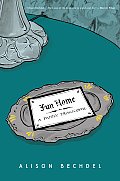
Fun Home, in contrast, is very tough stuff. Everything is completely interpersonal and specific. No one gets off the hook. You say at one point that you didn’t want to let your father become a martyr for you, because that would somehow excuse all the bad fathering he did. You don’t demonize your mother, though she’s the one who could be seen as keeping him in the closet, not understanding. Not to mention the way she handled your coming out. So what was it like for you to try to retain this firm hold on “objectivity” in the story? How did you think about this book in relation to your previous work and your existing audience, and how do you want to present this to a new audience? Is it an attempt to reach outside your established range, and get your work in the hands of new readers? (full disclosure: Mine was. I wanted to convince the world that I could do more than trace the small crises of urban hipsters; I wanted to crash through people’s expectations of my work, and make them realize I can deal with big difficult ideas.)
 Alison Bechdel: Honestly, I didn’t think about my audience—current or potential—as I was working on this book. If I had, I wouldn’t have been able to write it. It certainly was a stretch outside my established range, but I wasn’t trying to prove anything to anyone but myself.
I’ve gotten accustomed over the years to a certain critical invisibility. Dykes to Watch Out For has never gotten much attention outside of the (increasingly disintegrating and vitiated) queer subculture, and I confess to feeling somewhat bitter about that. But that lack of scrutiny has also given me a lot of creative freedom—with no one watching and nothing at stake, it’s easier to do whatever the hell you want.
I’m having an odd experience now with Fun Home because it’s starting to get a lot of attention even before it’s officially on the shelves. Obviously I’m very happy about that but it’s also a bit unnerving. In a way, I wasn’t expecting many people to actually see it; if I’d known it was going to get reviewed in the NYT Book Review and Time, I’m not sure I would have written such an intimate and revealing story.
I think some of my experience with the reception of this book is analogous to what’s happening for a lot of people from the comics world, as graphic novels become the next big thing. All of a sudden cartoonists are being “discovered,” which is kind of annoying when you’ve been there all along. I’m very grateful that Fun Home is being published by a major publisher and that it’s getting some attention, but in a bizarre way I feel envious of myself. How come DTWOF never got that kind of recognition? In contrast to your desire to crash through peoples’ expectations of your earlier stories, I feel determined to revise peoples’ expectations of DTWOF. I want them to take a closer look at it—or hey, I’ll settle for a look—and see that Fun Home is not such a radical departure.
I’m very proud of DTWOF. I think it’s a really good comic strip. But it’s also an aggressively marginal strip—I insist on writing about these queer characters in an authentic way, which might put off some non-gay readers. I also drag in some fairly complex political commentary that might alienate gay readers who just want to be amused. Plus I think a serial strip is rather demanding of readers in general—mine only comes out biweekly, and there are a lot of characters and stories to keep track of. You can’t just pick it up and immediately know what’s going on. In a way I’m working in a triple ghetto: queer subject matter, comics, and within the comics ghetto, the sub-ghetto of the strip format. That’s a lot of boxes to escape from.
I’ve been thinking about this marginality a lot lately, and wondering what purpose it serves for me. One of the things I write about in Fun Home is the inhibiting effect that my parents’ artistic passions had on my own creativity. My mom was an actress and played the piano. My dad was obsessed with the decorative arts and color. They both loved painting and literature and poetry. I theorize that I became a cartoonist by default—it was the only expressive medium left that they hadn’t colonized. It was a way of writing that wasn’t literary, and a way of drawing that wasn’t “artistic.” And it was black and white! No color! My parents had no aesthetic criteria for what I was doing, so I was free from their scrutiny and judgment.
I think I carried over my feelings about my parents’ judgment into my adult career. I disavowed any notion that I was an artist. My comic strip was journalism, or illustration, something populist and practical, not inaccessible and rarified like the kind of art and writing they admired. Instead of trying to become a fine artist or a literary writer, I threw myself into this aggressively lowbrow medium which was virtually criticism-proof because no one really took it seriously.
I began taking it very seriously, though, and it became my full-time job. But it wasn’t until I was nearly forty and starting work on Fun Home that I confronted my resistance to the “artist” identity. This project was much more serious and personal than my comic strip, and I had to accept that it was necessarily a literary undertaking. I realized when I was almost done with it that the real story of Fun Home isn’t my dad’s death, or our shared homosexuality, but my artistic apprenticeship to my father. And the book isn’t just about becoming an artist, it is art.
So I guess I’m coming out as an artist. And the timing works out nicely, of course, because it coincides with this moment when graphic narrative is finally being seen as a legitimate literary form. Of course, that means there are also aesthetic criteria for judging it, so it’s no longer the scrutiny-free zone it used to be. But I think I can handle it now.
5 June 2006 | author2author |
 Our Endless and Proper Work is my new book with Belt Publishing about starting (and sticking to) a productive writing practice.