
May 20, 2005
Author2Author: Tennessee Jones & Charlie Anders, pt. 4
The final installment in our conversation between Tennessee Jones and Charlie Anders, the two lead members of this spring's "Cross Gender Caravan" reading tour, hints at scenes of graphic violence; squeamish readers may want to just skip ahead to the next post, but Charlie makes a strong case for these scenes being integral to the work.
Tennessee Jones: There are two instances of self-mutilation in Choir Boy: one where Berry cuts his scrotum and another where he cuts one of his breasts after he has begun taking hormones. Are you concerned some readers will see these instances as expressions of internalized transphobia?
Charlie Anders: Feeling betrayed by your body, and wanting to do violence to it in retaliation, is a major theme in Choir Boy. I sort of hoped that this would come across as a human issue, not a transgender issue--everybody has experienced situations where his or her body rebelled or failed. From adolescence to old age, our bodies change and act without our consent. And I think I managed to work in all that weird stuff in the Bible about cutting off your hand if it offends you.I would say there's no way the first mutilation incident could reflect internalized transphobia, but you could definitely read that into the second incident. Berry is feeling freaked out by the way his body has changed since he's been on female hormones. In the context of the novel, it has to do with a lot of other stuff besides the fact that he's grown breasts, but yeah, he's partly feeling freaked out by his own trans-ness. I think it's important to talk about internalized transphobia, because most transpeople have dealt with it at one time or another. It's pretty impossible not to feel some self-loathing at times, when you have the whole arsenal of our culture aimed at telling you that you're sick or disgusting. Admitting to those feelings isn't the same as validating them, it's the first step to confronting them and telling them to go fuck themselves.
May 19, 2005
Author2Author: Charlie Anders & Tennessee Jones, pt. 3
Having probed the humor of Charlie's novel, our attention turns to the character development in Tennessee's short stories...
Charlie Anders: You and I, as transpeople, have had to reinvent ourselves to make our way in the world. A lot of the characters in Deliver Me from Nowhere seem unable to reinvent themselves. They don't believe in any future other than the lives their parents lived. I can only think of two characters in your who successfully reinvent themselves: the sister in "Mansion on the Hill" who gentrifies herself, and Caleb Wilson, the transman in "My Father's House" who first becomes a college professor and then moves with his lover into an isolated farmhouse. Why is the sister portrayed negatively while Caleb is portrayed positively? And why are these two characters able to reinvent themselves when nobody else can?
Tennessee Jones: The sister (who as an adult marries into wealth and denies not only her working class background, but also her family) is portrayed negatively because she doesn't necessarily reinvent herself. Rather, she capitulates to social pressures to feel ashamed about the employment and circumstances of her family. She denies her history without making peace with it, and cuts off contact with her family because she is unable to deal with her feelings regarding them. I don't think it's fair to always criticize people who "move beyond" the circumstances they were born to as betrayers, but in the case of this sister, it's apt. She traded in a relationship to her past and family for a new house and a clean slate, without any critical analysis of the value of any of these things.
The thing that separates the character of the sister and Caleb is self-criticism. Caleb is almost painfully aware of his surroundings, his conditions, and his desires. He tries with everything in him to confront the painful things both within himself and contained in his history. One of the big moments of transformation, or reinvention, in the story is when he goes home to his father after transitioning, is beaten up, and finally understands he has crossed a threshold that he cannot go back over. And, from that moment he moves on to shape the rest of his life.
Many of the characters in the book try to change their circumstances and fail, and much of the book is about how people deal with failure without being able to imagine new possibilities for themselves. It's unfortunate, but I believe this is indicative of the reality most people experience. Most of us live our lives pretty quietly, battling our shortcomings and fears, sometimes finding the strength to go after our dreams and desires, but more often lacking even the understanding of what those things are. Often following a strong desire, whether it's for writing or building cabinets, allows people to transcend their circumstances, to move beyond what might have been expected of them.
May 18, 2005
Author2Author: Tennessee Jones & Charlie Anders, pt. 2
The conversation between the two core members of the Cross Gender Caravan continues, as we learn about what makes Charlie Anders's debut novel tick...
Tennessee Jones: Choir Boy ends with Berry, your protagonist, experiencing a transcendent moment while he is singing in the choir. The preservation of his voice and his love for singing are the things that create the erratic and often painful, sometimes hilarious trajectory he follows. He seems willing to go through anything as long as he can keep singing. Your novel goes a long way towards uniting humor and sarcasm with transcendent, almost religious, experience and meaning. Was this a conscious decision, or something that came naturally from the work as it progressed?
Charlie Anders: Humor is like texture to me. I can't really believe in a fictional world unless it's full of ridiculous stuff. The "real" world is so absurd that I feel as though absurdism is the only true realism.
Writing Choir Boy, I guess I was very conscious of the need to create a context where the reader could understand Berry's actions. Berry's everyday surroundings are kind of bleak and bizarre, and his experience as a choirboy is beautiful and transformative. These are the two poles in his life, and he's strongly drawn towards the beauty and wonder of being a choirboy. So my natural tendency to portray the "real" world as silly and sometimes horrifying fed into Berry's desire to be something different. In particular, Berry feels strongly alienated from all the adult males in his world, except his choir conductor, so it made sense to portray all the men in a humorous way.
Also, that really was my experience as a choirboy: all the choirboys were sarcastic and profane as fuck. And then we would turn around and channel this awesome beauty and power that at times really did feel spiritual.
May 17, 2005
Author2Author: Charlie Anders & Tennessee Jones, pt. 1
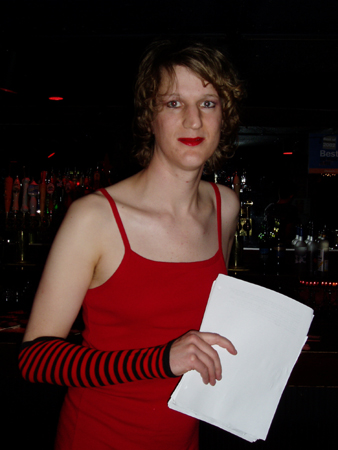
Earlier this year, Soft Skull authors Tennessee Jones (Deliver Me from Nowhere) and Charlie Anders (Choir Boy) set out on a 30-city tour with the "Cross Gender Caravan," billed as "a night of cutting-edge fiction and poetry from young transgender writers." (Pictures from the Boston stop are online, including the shot of Charlie I've used here.) It seemed like a pretty good reason to start an Author2Author dialogue, so I sent out some emails and the conversation started with a question about Tennessee's extra-literary sources...
 Charlie Anders: How many times did you listen to the Nebraska album when you were writing Deliver Me From Nowhere? Did you keep finding new things in it, or did it sort of become background noise? How did you keep it fresh in your ears?
Tennessee Jones: I listened to Nebraska too many times to count. The record both faded and stayed fresh as I was writing. One of the things I did to keep it interesting for me was play music with similar themes, and pay attention to how different artists handled questions of faith, isolation, redemption, etc. The American Recordings boxset of outtakes from Johnny Cash's latter albums was a huge favorite, as well as Billie Holiday, Dolly Parton, Gillian Welch, miscellaneous southern gospel artists, and pretty much anything by Sam Cooke.