
April 17, 2005
Author2Author: Helen Ellis & Joshilyn Jackson, conclusion
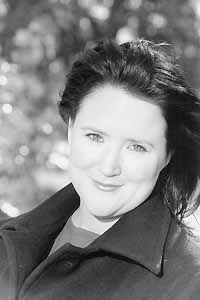 Helen Ellis (left): In gods in Alabama, a lot of pains are taken by characters to hide what has happened to them to spare others' feelings. (I'm thinking in particular about what is hidden from Arlene's aunt, and being intentionally vague so as not to give away too much plot.) You often read about women who pretend bad things never happened to them for their own sanity, but in this case, the charade was created to save the aunt from pain that she' d feel over what happened to someone else. Do you get what I'm asking? Why don't people share their deepest pain with the ones who love them most?
Joshilyn Jackson (right): It's hard to answer this without, as you said, explicating the plot. I think everyone is this book is more loved than they think they are. Arlene certainly is. (At this point, I need Doctor Phil to step in looking moist and sincere and say in a rich, fruity voice, "Part of being loved is accepting the idea that you deserve it!" Then we could all hug.)
But I think this question is actually connected to what we were talking about earlier: You know, early in the book Arlene's descriptions dovetail with the descriptions of Chicago. She's all angles and corners, much too tidy to be anything but meticulously planned. As she goes south, that changes. She doesn't stay Chicago Lena, but she doesn't revert to being the out-of-control Arlene who at fifteen crept up to the top of Lipsmack Hill to beat a boy to death with a tequila bottle. Lena at the beginning is a tightly wound wad of secrets that is dying to explode and unravel and confess. But for the Arlene she has become by end of the book, part of loving is knowing what secrets to keep, even if witholding them costs her a piece of her own absolution. I'd like to argue this one with you sometime, because I do believe she makes the correct choice. And yes, by correct, I mean I think she is doing what is right, even if it is perhaps ethically bankrupt.
This whole conversation makes me want to talk about the rather disturbing end of Eating the Cheshire Cat, but without somehow summarizing the entire plot. One of your main characters makes a very final choice that I didn't think was morally or ethically right, but I couldn't help but find it terribly satisfying. Do you think she was justified, or does that matter?
Helen Ellis: Aren't we the little devils; we do both hurt our characters in peculiar over-the-top ways. Perhaps this is because, being raised as southern ladies, our violent tendencies were so repressed by society or blamed on our periods.Nope, I don't think the girl who causes the big bang at the end of the novel was ethically right, but it is a happy ending in my mind. What this character learned, we all learn: Life isn't fair. So she took justice and karma into her own hands and rubbed them like two stick to start a fire. BOOM!
If there's one thing I regret with that book, it is the title. Number one, nobody can understand my accent when I say it and everyone asks me to repeat myself. "Doin' what with the what-what?" Number two, it was just too clever for my own good. The title stems from the scene in Alice in Wonderland in which the cheshire cat taunts Alice: "You must be crazy or you wouldn't have come here." In my mind, the book and the finale to which you refer are about taking a bite out of your antagonizer's ass. But nobody gets it.
A newspaper editor and friend of my husband gave me this advice: "When writing, put the dog food where the dog can see it." In other words, make it easy on the reader. He suggested the title for my next book: How I Killed My Husband and Got Away With It: An Autobiography.
April 15, 2005
Author2Author: Joshilyn Jackson & Helen Ellis, pt. 4
As is often the case, look for a special bonus round of questions and answers between Helen and Joshilyn over the weekend!
Joshilyn Jackson: Reading Eating the Cheshire Cat, I was struck by the intensity of the various power struggles--wars actually--being waged, often silently, by female characters against each other. Is this sort of smiling territorialism Southern? Or female? Or simply human?
Helen Ellis: Good question. You may be the first person who pulled out the fact that so many of the attacks are silent. I don't think I noticed it myself! But it's true. I wonder if it's particularly southern and woman related. Being that I didn't notice, maybe it's inbred.I know that southern ladies are raised to be ladies in public. I myself was told by my Mama, "You can say anything you want about somebody else as long as you do it in the privacy of your own home." You never know who's sitting behind you at the movie theater (or football stadium or classroom) to overhear. Living in New York City, you can hear women on public transportation loudly confront riders who don't give up seats for old women--though it's my opinion if you're going to have plastic surgery to look younger, I'm going to treat you as such. Full lips, smooth forehead, and osteoporosis? Hang onto the strap, sister, you're standing all the way up Madison Avenue!
April 14, 2005
Author2Author: Helen Ellis & Joshilyn Jackson, pt. 3
Helen's enthusiasm for Joshilyn's debut novel, gods in Alabama, remains strong as their conversation continues...
Helen Ellis: You write particularly well about bad sex. Do you find it easier to write what's difficult--either for your characters to experience or for you as a writer to write--in the face of what yo' Mama might think?
Joshilyn Jackson: You never realize exactly how much sex (and swearing! and violence! and perversion! and, and, and...tackiness!) is in your novel until the day your Belle of a Mama calls you and says, "Daddy and I are just lovin' your book, sugah. We're reading a chapter aloud to each other every night at bedtime." The idea of my mother reading some of those scenes, saying some of those lines, out loud, in bed, to my father...I must shudder and avert my eyes from what's tantamount to a literary primal scene.
Also, I hate writing "good" sex scenes. Bad sex is much easier to write. It isn't personal. I had distance from it because my main character , Arlene, also is distant. She's practically in Alaska for a few of those hay rolls, so she has room to be cynical and funny and clinical and observant. The much harder scenes were the ones where good sex happens. I must have rewritten those scenes thirty times because, hey, sex is nice, people like sex, we have it as often as we can manage it and it usually works out for us. So I was describing something that most people have experienced and have read about nine thousand times, and it is much more personal. I'd catch myself hiding in cliché and overblown prose and have to start over. I am horrified by florid lurve-prose, and if I got too purple I don't think I would respect myself in the morning.
April 13, 2005
Author2Author: Joshilyn Jackson & Helen Ellis, pt. 2
Joshilyn Jackson: What scene or character began Eating the Cheshire Cat? The opening is a blend of black humor and horror that I find particularly compelling, but I always wondered if that was actually the first scene you wrote, or if you began with Bitty Jack, who is the heart of the book.
Helen Ellis: The first chapter of Eating the Cheshire Cat sprang from an awful first draft that mentioned the "pinky thing" in a one-liner. The earlier draft was being workshopped at the Sewanee Writers' Conference and Alice McDermott told me that the one- liner about Sarina peeked her interest. She said--and this was good advice--"Not all characters are one hundred percent good or one hundred percent bad." So I asked myself, What kind of girl would have her fingers broken to be perfect? And what kind of southern mother would do it? Then I wrote the chapter in two hours on a rainy afternoon in Tennessee. Bitty Jack, Nicole and other characters were already present, but they and their motivations changed over the three years it took to write book. Like you, I always knew I would be a novelist. I just had no idea how hard and time consuming it would be.
April 12, 2005
Author2Author: Helen Ellis & Joshilyn Jackson, pt. 1
Pretty soon after the ARC for gods in Alabama showed up in my mailbox, I figured I had to set Joshilyn Jackson up with Helen Ellis. It turned out Joshilyn had already read (and was crazy about) Helen's Eating the Cheshire Cat, so she was excited to hear how Helen might react to her debut novel, which you can find in bookstores this week.
Helen Ellis (left): I loved gods in Alabama. While reading, I laughed (intro to Lipsmack Hill) and gasped (most embarrassing high school cafeteria moment ever) out loud in public places. The last time a book had me doing this was Empire Falls by Richard Russo, which I read several years ago. So, bravo! Now, tell me, being that this is your first novel and you were clearly born to write books, what prompted you to sit down and do it?
I've wanted to be a writer for as long as I can remember. My mother has a humiliating number of "books" I created via Crayon-and-Staple-on-Demand Publishing, and I was four when I told her I wanted to "write the great American novel." Yes, God help me, in those exact words. But it's such a tough world. When I got an agent, I was dewy and hapless and my ear-fronds were still damp. I didn't know I needed to grow a thick, horned callous over all my soft bits. I got a little bit broken.
I didn't want to have a weepy dramatic break-up scene with my agent. I thought, "Well, I just won't call him, the relationship will peter out, and I can concentrate on writing. Remember writing? The part you really really like?" So that's what I did. I was working on a play, a couple of stories. After months of silence, he sent me a letter. "When am I going to see your next novel?" it read. "You know you really are one of my favorite writers."
That was so compelling, to have this man--and you know agents are supposed to be half shark--treat me with respect and interest, as if I were an established writer when all I had done at that point was cost him a lot of copying fees. And maybe I had grown up a little. I'd had a novel brewing in the back of my head for quite some time. The main characters, Arlene and Burr, first appeared in a short story I'd written at least seven years earlier. There was something about Arlene that caught my eye whenever I looked back at that story, even though she only appears in about ten lines and the narrator of the story hates her guts. After I got his note, I sat down and started writing about her, and her story grew into gods in Alabama.
photo of Helen Ellis by John Anderson