The Beatrice Interview: Catherine Bush (2000)
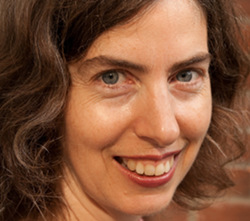
I sit with Catherine Bush at a table in the crowded coffeeshop of one of Manhattan’s many Barnes and Noble shops, chatting amiably before her scheduled reading. The conversation turns to our favorite authors: “I constantly go back to Michael Ondaatje,” she says. “He creates such amazing scenes and is such an extraordinarily lyric writer. I find his latest, Anil’s Ghost, very interesting because it comes at issues of contemporary warfare from a very different angle than my book does. It’s interesting to think of our two books as part of a larger dialogue.” Her novel, The Rules of Engagement, is the story of Arcadia Hearne, a Canadian woman who works in London as a researcher in “Contemporary War Studies.” A series of events that begins with a surprise visit from her sister, a globetrotting journalist, forces her to confront the effects of modern war in a much more emotional context, and lead her to reexamine the violent circumstances that prompted her to flee Canada a decade before.
Why was there such a long gap between your first novel, Minus Time, and The Rules of Engagement?
Novels take the length of time they take, and you can’t predict in advance how long that will be. Minus Time took me four and a half years to write. I’m not a demon speed queen who turns out novels in one or two years. Maybe one day I’ll write a book that won’t take me that long, but these two books did. We live in a marketplace that urges us to put out things really quickly, but I think that we need time to rejuvenate, to recuperate. I had to find a way to do that. And I also had to support myself. I had a full-time teaching job for two years. I also had some muscular problems, a bad case of repetitive stress injury, and spent a lot of time in physiotherapy. But I don’t know if this book could have been written any faster if those things hadn’t occurred.
If somebody had told me when I started Rules that I’d work on it for six and a half years, I probably would have been aghast, but then you get into the work and it sets its own demands. You have to keep writing until it’s as good as it can be. Early on, I put a lot of external pressure on myself to try to finish it more quickly, and then I realized the thematic challenges I’d set up for myself were just taking time for me to work out.
And I also started thinking of writing the book as a process of becoming the person who could write the book I wanted to write. Both books have been journeys of discovery for me. There were things that I wanted to know and didn’t know, so I had to figure out how to find them out, how to tell the story.
What was the first thing that you wanted to know when you started Rules?
I started with the idea of a woman who writes about war theory and has a duel fought over her. I just loved the coming together of someone who writes about, and intellectualizes, violence and war and also has this bizarre violent event in her own life. I wanted to talk about violence, confront it in myself, to think about it in ways that I had resisted thinking about it, and a duel seemed to be an interesting angle at which to come at the issue. It was also a way for me to talk about some early relationships in my own life, and the kind of intensity that early relationships often have. Even if they don’t lead to duels, they can still be deeply shaping and scarring, and we all live with the legacies of those intense relationships.
One of the first challenges of this story is to create a psychologically convincing fiction in which the idea of fighting a duel in the modern world becomes plausible, and the reactions to it seem realistic.
Exactly. I like books that take that kind of dare, and I like to make myself those kinds of dares. It interested me to take a lot of nineteenth-century overtones and a veneer of romance, something that seems very historical, and put it at the end of the twentieth century–see what we, with our modern mindsets, would do. But whether a duel is fought in the nineteenth century or the twentieth, I’m really interested in what it feels like to have a duel fought over you. That story isn’t told in traditional dueling literature, which is all about the guys who fight. Duels aren’t always fought over women, but they usually are, and I wonder, what’s it like to be fought over? What sort of scars does it leave?
There are elements of the story that could be, in another context, the basis of a political thriller, but you keep them grounded in the characters’ personal situations.
I’ve just started work on a new book, so I’ve been thinking about the types of books I love to read and ideally would like to write, and I keep thinking about a book that would be the secret love child of Alice Munro and Haruki Murakami. One of the things I love about Murakami’s work, especially The Wind-Up Bird Chronicle, is the way he’ll take the conventions of, say, the detective genre and then build a very literary overlay on them. But I like the element of mystery that’s embedded in the story, that keeps you reading. You also see that in Paul Auster’s work… I like that element of suspense, of motion in a story, and as a writer I’d like to be able to pull the reader along in that way.
We all have secrets of one kind of another. We’re all forced to confront various situations where we either take risks or don’t—emotional risks, psychological risks. And I’ve spent a lot of time travelling between countries. My family’s originally from England, then we moved to Canada, where I live now. I lived in the United States for ten years, and when I was writing this book, I spent a lot of time in London for research. So I live my life on this weird, triangulated axis between three countries, and I think a lot of my obsession with geographical displacement, and people who live between borders, comes out of my own experiences.
And you’re always in a funny position as a Canadian, because you’re innocuous and invisible and usually mistaken for an American overseas. At the same time, our neutrality has its own desirability. Canadian passports are the most forged in the world; when I found that out, I was fascinated. I knew I had to write about it somehow.
Other people’s reactions when they learn about the duel are an important part of the story. What sort of reactions did you face when you told—and tell—people you were writing a novel about a duel in modern-day Toronto?
At first they don’t quite understand what you’ve said, so you start making pistol signs in the air with your hands. “You know, a duel, with pistols…” And then they ask, “When is the book set again?” I like being able to take people by surprise like that, though. Some people have told me that it’s too extraordinary, how could something like that happen in Toronto? But my feeling is that stuff happens everywhere, weird, violent stuff. I remember riding in a cab in Montreal, wtih a Yugoslavian cab driver, describing his conversations with Quebecois about the civil wars in Yugoslavia. They would tell him, “It could never happen here. We’re not violent.” And he would always tell them, “You may not be violent, but you can become violent.”
Young men, especially, can be so volatile, can believe themselves to be invincible. That’s a global phenomenon. On that level, the idea of a duel doesn’t seem so surprising to me. And Toronto has such a reputation for being nice and staid that I liked to shake up its literary image a bit. It also has these ravines where various writers, including Margaret Atwood, have placed weird, wild, terrible events. If weird stuff happens in Toronto, it’ll happen in the ravines; they’re a wild country within our city.
How early on in your life did you know writing was what you wanted to do?
I wrote my first novel, which I didn’t finish, when I was ten, about a group of kids who take over a spaceship, and then I wrote another one when I was eleven. I wrote a lot in college, and after I graduated I moved to New York. When I lived here, my main professional life was as a dance and performance critic. I think I just needed to get away from an academic environment, get out and live some more, until I had something to write about.
So I was always writing, but it took me a long time to think that I could be a writer, in the professional sense, and to choose what kind of writing I was going to do. When I was in my mid-twenties, I decided that I wanted to write a novel, and I really had to streamline my life to make this possible. It was a gamble that I had to take; I wouldn’t be able to live with myself otherwise. And since then, I’ve never looked back.
photo: Ayelet Tsabari
 Our Endless and Proper Work is my new book with Belt Publishing about starting (and sticking to) a productive writing practice.