The Beatrice Interview: Sara Gran (2002)
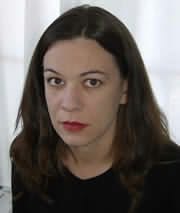
The title of Saturn’s Return to New York comes from a prominent feature in the astrological chart that the novel’s protagonist, Mary Forrest, gets for her twenty-ninth birthday. It seems that this is the year that Saturn returns to its original position in her birth chart, bringing with it a slew of personal upheavals. Soon Mary finds herself trying to cope with her mother’s increasingly frequent memory lapses, the return of a vanished lover, and–for comic relief–the ultimate in insane, backstabbing coworkers. Those scenes, set in the offices of an online bookseller, seemed to mirror my own experiences working for online booksellers so accurately that I was sure Sara Gran must have been working for the “noble” competition. But Gran soon set me straight. “I had been working in bookstores for a long time,” she said over lunch at the Boerum Hill Food Company, “and when I started the novel, I was managing a small bookstore, so I guess I thought of that as maybe the next step up in a bookselling career. And it was something I’d always thought was interesting, something I’d like to do. But I don’t even know anyone who works for a company like that.”
What made you want to sit down and write this novel?
There was no one thing in particular, no one driving focus. I was writing another book, and I got halfway into it, and I realized that two of the characters in it, a mother and daughter who talked about living in New York, were so much more interesting than everything else I was doing in the story. So I just started a new book with them. That other book was really a mishmash. I had all these ideas that I threw into that story because it’s what I was working on at the time, but I realized later on that they were really ideas for several different stories that I just squished together.
New York is still a very important component of the relationship between Mary and her mother.
It seems more commonplace now to comment on how much the city has changed over the last couple years, but when I started writing this novel, it was at the moment that those changes were just beginning to take place—all around me, it felt like. Now we’re all used to seeing a Duane Reade on every corner, and Domino’s everywhere, thousands of people moving here… Even three years ago, when I started writing, those changes didn’t seem commonplace at all.
Was that novel you abandoned halfway through your first try?
No, I actually wrote an entire novel previous to that, which was never published, for which I’m now very glad. I spent about six months sending that novel out to agents and publishers and getting mixed rejection letters, some of which were nice at least. There were a lot of suggestions on revisions, and I really didn’t want to revise it, so I decided to start something else instead. So I started that… which, come to think of it, I’d actually started halfway through that first book.
Writing was always something I enjoyed, and I started thinking seriously about it as a career at the end of college, and the real decision came about a year after I graduated, when I was living in the city again. You know how it is, you try different jobs until you figure out what it is you want to do. Working in an office turned out to be not for me, not at all. I would just sit there at my desk and cry sometimes, and that was when I realized that I was spending all my free time writing because that was what I really wanted as a career.
What’s your personal take on astrology?
I love astrology, but it’s not like I have a literal belief in it. And when I say astrology, I’m not talking about the stuff in the daily paper, but about getting your chart constructed, having it read. When you get to that level, it’s very useful, very helpful, and there’s a lot of truth in it. You would never want to be one of those people who can’t do something because their moon is in Venus that day, but I still think there’s a lot of truth in it.
I have a friend who knows his way around constructing birth charts, and he helped me out with Mary’s chart, figuring out the houses and the signs.There’s a few inaccuracies, to be honest—a few manipulations I had to make, moving a planet from one house to another because that was where I needed it to be for the story. But it was mostly a real, accurate chart.
I’ve always thought astrology—and tarot cards, too—can potentially be very interesting tools for writers. You don’t necessarily have to have a literal belief in their validity, but they can provide very interesting narrative structures.
They give you useful metaphors for organizing the way you look at a story. It’s just another way of looking at the world around you. You could say you got a certain tarot card in your reading, or you have a Saturn return–they’re just metaphors to help you understand a certain time in your life. They’re a basis, a starting point. Like with tarot; you can go in any number of directions with a given card, except usually the Tower. I did a reading for myself recently and got the Tower in my immediate future, and I was a little freaked out about that…
Although for New Yorkers, it might be the perfect image to represent our immediate pasts… I’ve talked to a couple writers about the difficulties of writing about life in New York after September 11th. What are your thoughts?
It’s really hard to conceptualize right now. You either have to spend a lot of time figuring out how to deal with the changes, or you have to set it in the past. It’s similar to the way we have to make sense of this in our personal lives–you can’t spend every moment thinking about it, but sometimes you just feel as if you have to. It is the most momentous thing that’s happened in my life, in the lives of just about anyone you or I know in New York. But you have to get on with your life somehow… It’ll be interesting to see how authors deal with that, with how this one day had such a huge impact on all our lives. I don’t know what I’m going to do when I get to the point in my current story that I have to deal with that, and I’m worried about it.
How was your 29th year?
Certainly not as big as it was for Mary. But there is that thing about turning 30… and I’d read somewhere recently that maybe the reason that the dread of turning 30 is so universal has to do with Saturn’s return. I just turned 30 a few weeks ago, but I didn’t have any huge outward changes. No deaths in the family, no bankruptcy. So now that I’m past that, it doesn’t seem like a big deal to be 30, but for the last few months… I was glad to have the book come about before my thirtieth birthday, so at least I had that one huge plus in my favor for my first 29 years.
I just turned in another book to my agent, waiting to hear back from her about the revisions I’ve made at her suggestions. It’s about somebody who’s possessed by a demon.
Have all of your stories had these fantastic elements?
Not until Saturn’s Return, really. But I’ve always been into that stuff. I’ve read tarot cards for years, and I grew up reading about Bigfoot and ESP… The astrology was one of the last things I added to this novel, actually.
Sometimes it doesn’t seem like that sort of material is “up to par,” that it’s not good enough to put into a serious or literary fiction. But it’s what I like, it’s what I’m interested in. Still, the novel I’ve just started doesn’t have anything like that.
Who are some of your favorite writers?
I just read Anagrams, by Lorrie Moore. It was so good that when I got to the end I went right back and read it again. I can’t recommend that book highly enough. Right now I’m rereading Nicholson Baker’s Room Temperature for about the third or fourth time. He’s one of my favorite writers.
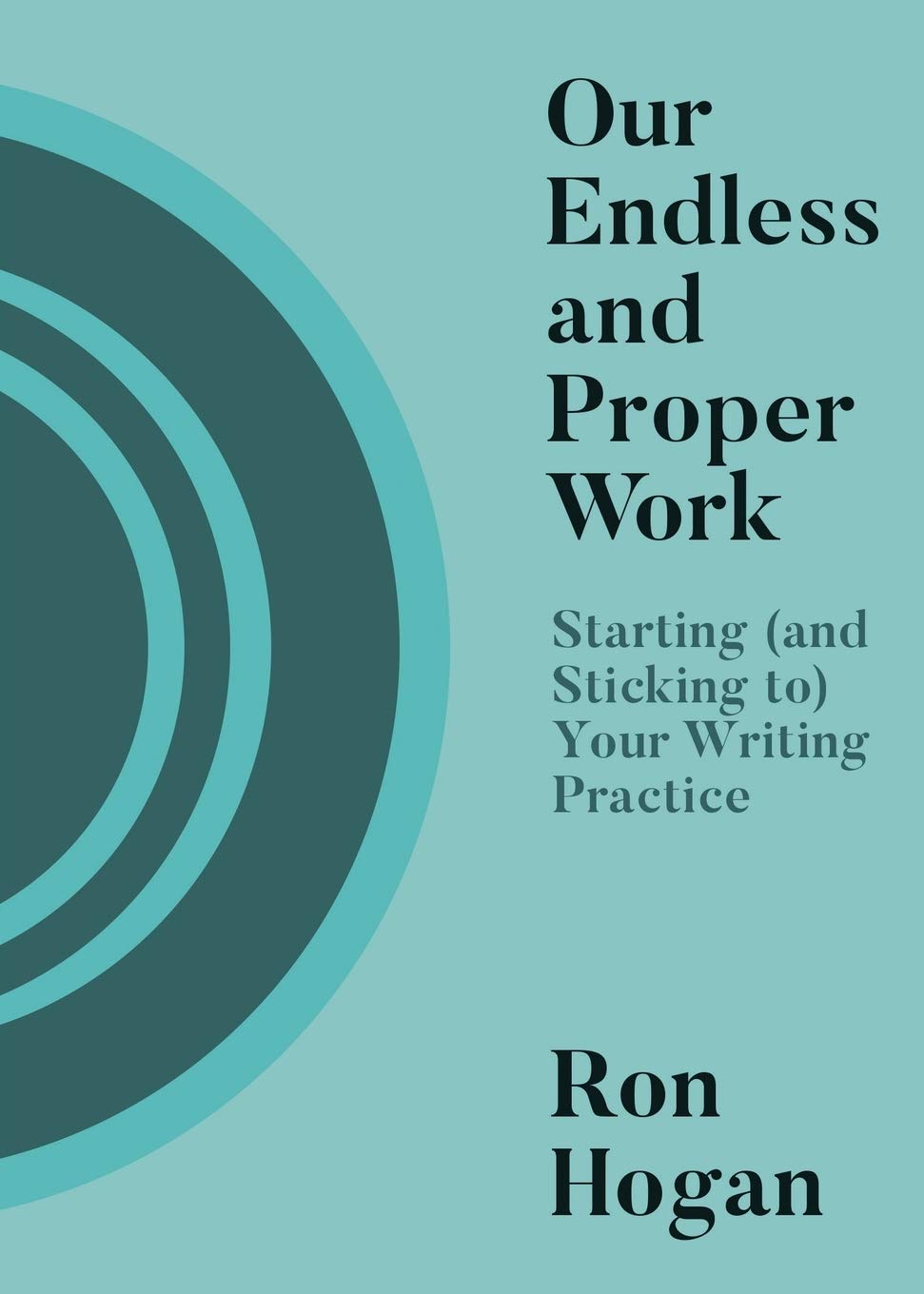 Our Endless and Proper Work is my new book with Belt Publishing about starting (and sticking to) a productive writing practice.