You Should Read Casey Plett’s On Community
I’m lucky enough to be acquainted with writer Casey Plett, from the days when I was covering the literary world and she was a publicist for the indie Canadian press Biblioasis, which happens to be the publisher of her recent long personal essay, On Community. So I was delighted to see her launch the book a few months ago at McNally Jackson in Manhattan, and I’ve been thinking a lot about what she’s written since then. Some of what she says draws upon her experience growing up in Mennonite communities, some of it draws upon her experience in literary communities, and some of it draws upon her experience living in trans communities.
(One of the first things she makes clear, in fact, is that it’s often not helpful to speak of “community” in a totalizing, comprehensive way, that what outsiders might see as a community can often be a cluster of communities, sometimes overlapping, sometimes at odds with one another.)
In particular, I’ve been thinking about her thoughts on compassion, and the way that grounding her life in a conscious rejection of “insularity, cliquishness [and] suspicion towards outsiders” has improved her life, how it “actually helped me unstick myself from cycles of anger and move on.”
“I looked into the future of this tendency I was developing to be fearful and avoidant of strangers,”she says of one time in her life, “and I saw only resentment and darkness. And the unfair thing about resentment is that it doesn’t matter if its source is honourable or petulant, it makes you twisted just the same.”
I think about the kind of compassion and openness to strangers that Casey’s writing about in spiritual terms, but also in terms of being a writer—partly because the two have become increasingly intertwined in my mind in recent years.
Let me see if I can explain this. I believe that we write because we have something—a story, a message, call it what you will—that we feel driven to share with the world. We work at our craft to improve our ability to do that work of sharing, to be seen and understood. But in order to make ourselves understood by others, it’s vital for us to be capable of understanding others ourselves—to be capable of recognizing that everyone has something to share with the world, even if they aren’t working at it, even if they aren’t even conscious of what it is yet.
Among the Quakers, where I’ve made my spiritual community for the last few years, we say that there is “that of God in everyone.” Which means different things to different Quakers, but I see it as a recognition of a basic equality among all. I almost said sameness, but of course we’re all fabulously different, yet behind all those differences we are all equally beloved and welcomed by God—and it’s our job to do our best to mirror God’s loving welcome in our interactions with others, with compassion and empathy.
From a literary perspective, that means we need compassion and empathy not just in trying to write about others, but in reading their stories. In the final pages of Our Endless and Proper Work, which were written shortly after the Trump-led insurrection against the United States government, I talked about why authoritarians and fascists seek to stamp out other people’s stories, how they strive to make sure that their voices are the only voices that get heard. One of the main reasons is that they know that, in a truly free “marketplace of ideas,” what they have to offer—power for themselves and their accomplices, suffering for everyone else—is simply not that attractive a deal. So they do their best to make sure people don’t hear about the other options available, until they can make sure those options are no longer available.
This brings us back to Casey and the motivations behind her engagement with trans literary communities. “One reason is simply that trans people are a minority under frequent discrimination and attack,” she writes, “and we live more marginalized lives compared with the average population… and I want to do my part against such marginalization.” But the other is deceptively simple: “It’s a world I ended up in and a world I can contribute to… It’s what I ended up knowing how to do.”
The more time you spend actively engaged in a community, interacting with other people and forming relationships with them, the deeper your roots in that community can grow—and the better you can become at doing the work of that community. If that work is protecting marginalized people through political and social action, solidarity with others will help you get better at that. If that work is writing or some other form of creative activity, solidarity with others will help you get better at that, too. Because you will want to do better not just for yourself, but for your community.
“I don’t know how it’ll pan out,” Casey says of her work. “But it’s what I believe in and what I know how to do. I’m sticking with it… These conclusions make my life better, and they give me stuff I can do, ways to give my time to the world. Maybe you have your own small, manageable things in your life and heart that you know too?”
Whatever those things are, stick with them, and see them through. Nurture them, and share them with the rest of us.
That’s as good a place as any, I suppose, to transition to an update on the “Substackers Against Nazis” open letter I shared in mid-December. For those who are just tuning in: Substack, the technology platform that hosts my newsletter, also hosts a number of newsletters unabashedly grounded in Nazi ideology, and that pisses off many of us who publish our newsletters through Substack.
So the open letter got published, and its theme was, in essence: “Hey, we notice you’re doing business with Nazis. Are you going to keep doing business with Nazis? Because if you are, maybe some of us don’t want to do business with you.”
To which Substack co-founder Hamish McKenzie replied, in essence, “Look, I don’ like Nazis, but there’s nothing wrong with doing business with them.” Heck, he argued, our commitment to free speech practically requires us to do business with Nazis. I was not surprised by this, because it’s entirely consistent with Hamish and Substack’s response two years ago, when the company was confronted over its financial support of writers spouting transphobic ideologies, and said it didn’t see a problem with them.
Substack didn’t, and doesn’t, really care what any of us write in our newsletters. What matters to them is whether they can make money from it, and the bank takes money that Substack makes doing business with Nazis, and transphobes, just as eagerly as it takes all the other money Substack makes.
My response two years ago was to stop charging money for this newsletter, so their cut of nothing would be nothing. Other people chose to stop working with Substack and move their newsletters to other platforms then, and other people have chosen to stop working with Substack in the last month. I encourage everyone who publishes a newsletter on Substack, or is thinking about it, to make the right choice for them, and for their situation. As for me, I’m choosing to stay not just because I’ve cut off any money they might have made from people paying for this newsletter, but because I like the technology, and if I were to leave there is no guarantee that whatever newsletter platform I selected wouldn’t wind up having its own Nazi problem. Anne Helen Petersen, one of Substack’s most prominent success stories on both the financial and cultural levels, sums this up neatly in explaining her decision to stay:
“The Nazis would come there, too, because part of what Nazis want to do is to make life worse for anyone who opposes their ideology. They want to make it harder for you to read the people you want to read and harder for me to write the non-Nazi things I want to write, and they want us to talk about them. Their business model is simple, and a significant part of it is ruining ours.”
But there’s more news in this whole situation. Earlier today, another prominent Substack newsletter, Casey Newton’s Platformer, reported that “Substack is removing some publications that express support for Nazis.” Substack claims “this did not represent a reversal of its previous stance, but rather the result of reconsidering how it interprets its existing policies.” That reconsideration, Substack continued, “will not include proactively removing content related to neo-Nazis and far-right extremism,” but applies to any newsletters that publish “credible threats of physical harm.”
In other words, it’s still okay to espouse Nazi ideology on Substack, as long as you don’t explicitly call for anyone to be beaten or killed or herded into concentration camps—or, at least, if you don’t do that in front of a large enough audience that people who aren’t Nazis eventually get wind of it.
The organizers of “Substackers Against Nazis” are grabbing onto whatever aspect of this they can claim as a victory, and as someone who signed the open letter, I can’t say that I blame them, but as you might be able to guess I don’t really see this as much of a win. Sure, it’s great that a few virulent Nazis are going to have to go find someplace else to peddle their wares, but Substack’s larger Nazi problem remains—and as Jude Doyle and others have been pointing out, the reason Substack has a Nazi problem in 2024 is because they didn’t face substantial enough setbacks for the transphobia problem they had in 2021.
And the reason for that is because American (and not just American) society didn’t do enough to deal with its transphobia problem, and so now American society has a Nazi problem in 2024. (It wasn’t just the transphobia problem, of course; it was a broader Christian nationalist white supremacist problem. But transphobia is a very effective tip of the fascist spear; once they start getting people to buy into that, they increase their existing efforts into suppressing other marginalized groups.)
I could go on in this vein, and I probably will at some point, but for now let’s just circle back to On Community, which you should absolutely buy, and read, and if you’re in a community already, maybe it will help you consciously strengthen your ties to that community, and if you aren’t actively involved in a community, maybe it’ll help you to understand where your community might be, and how you might become involved. Because, at the risk of repeating myself, the solidarity of embracing our neighbors, of loving them as we love ourselves, to coin a phrase, is the way to keep fascism from gaining so strong a grip on our culture that we’d end up having to go to war to rip it out of our civic infrastructure.
This post was first published in “Destroy Your Safe and Happy Lives,” a newsletter I’ve been writing since 2018. If you’d like to subscribe and get every new installment delivered to your email (free!), you can do that here.
9 January 2024 | newsletter |
Overwhelming Fear with Acceptance
Recently, someone steered me toward a GQ profile of golf coach George Gankas:
Gankas’s great flaw as a player, in retrospect, was fear. Now he teaches his students to overwhelm fear with acceptance. Stay present, he says. When you’re out on the golf course, don’t get too sunk into yourself; look up from the ball, at the beauty of the natural world, and get outside your own traitorous body, your own monstrous ego.
“For me, to always look up and out is huge because I can see detail in the trees,†Gankas told me. “It gets me present. It gets me out of my head.†He said that lately his eyesight, which had been excellent, had begun to fail him. “I need to get my eyes fixed so I can get back to that. Because if I’m in my head, I’m miserable. I’m running through thoughts. And a lot of times, that’s not where I want to be. So I teach my players to stay present. And if I’m not doing it myself, I’m not going to teach them to do it.â€
That sounds familiar to me, even though it’s been about thirty years since I last went out on a golf course (in part because I was never particularly very good at it). I think a lot of us have probably experienced something similar in our writing practices—those days when we spend so much time wrestling with our anxieties and fears that we’re unable to focus clearly on the story.
We find our way out of that dilemma following much the same path Gankas recommends to his students—by setting ourselves aside, and paying attention to the moment in the story that’s before us. (Or it could be a poetic image! I just happen to have a mental bias toward narrative.) Stop worrying about your ability or inability to put that moment into words; just be with it for a while. As you do, you’ll begin to understand what needs to be said in order to describe that moment, and you will write. You may not find the exact right words the first time, but don’t worry. You can figure that out later, if you need to. (If you do get it right the first time, way to go!)
Of course you haven’t really taken your mind out of the picture entirely. You’re still there, picking and choosing your moments, picking and choosing the words to describe those moments. You’re not just channeling raw unfiltered prose from some extra-dimensional literary realm—and if you’re like me, you’re very conscious about all that, pausing, reviewing, and revising as you go along, even in the “first†draft, long before another set of eyes takes it in.
The trick is, though, that I’m not questioning whether I can do it, no matter how long it takes me to figure out how to do it. (Which is not to say I couldn’t still screw it up, all the same! If I do, though, I’ll have to have another go at it. Maybe more.)
I recently spoke with memoirist Lara Lillibridge for a literary magazine called Hippocampus, and one of the things we wound up discussing was the source of this newsletter’s title. It’s the opening to one of my favorite Mekons songs, “Memphis, Egypt,†and the full line goes: “Destroy your safe and happy lives / before it is too late.â€
It’s been a song that has stuck with me for decades, and it felt really apt to use it to talk about the writing life. I mean, you don’t become a writer because you’re complacent. You become a writer because there are things picking away at you—things you have to get out. And in order to get them out, sometimes you have to blow up your routine and find a new way of doing things.
I also want to share an interview I did with Hurley Winkler for her Lonely Victories newsletter back in June! One of my favorite moments in that conversation was about that process of destroying our safe and happy lives and finding that new path. Carving time out of your schedule to focus on your writing is important, but there’s more to a writing practice than just picking up the pen or sitting in front of the keyboard.
I believe that, to the extent possible, when life presents us with options, it’s desirable to make choices that nourish our writing practices—not all of which involve the act of writing. That’s important, obviously, but it’s also important to cultivate inspiration and practice empathy and compassion. All three of those will lead to better writing down the line.
When you’re able to approach your story with empathy and compassion, when you’re able to take inspiration from the example set by others… these are all good ways of setting yourself aside and accepting the task that awaits you.
This post was first published in “Destroy Your Safe and Happy Lives,†a newsletter I’ve been writing since 2018. If you’d like to subscribe and get every new installment delivered to your email (free!), you can do that here.
12 August 2021 | newsletter |
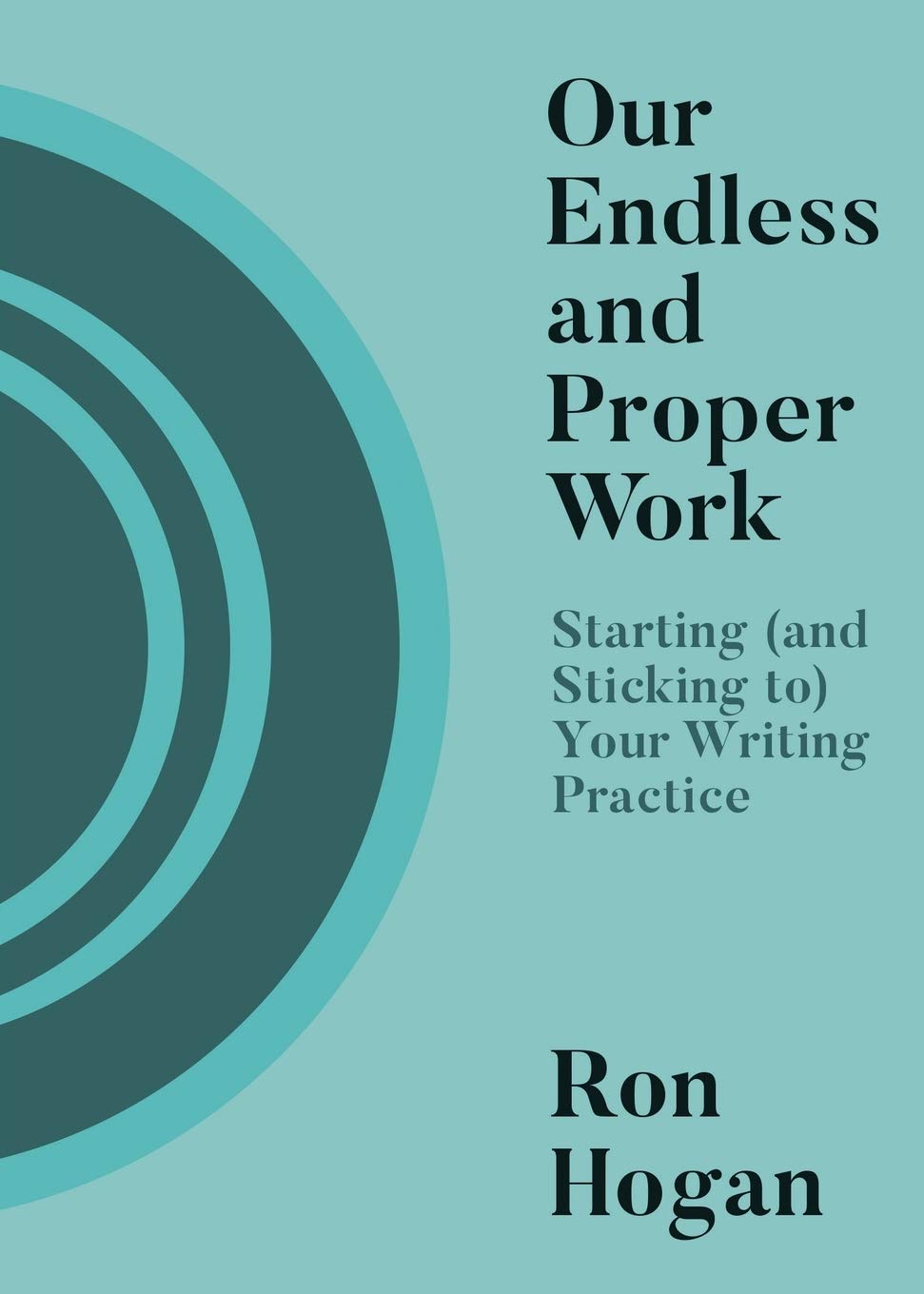 Our Endless and Proper Work is my new book with Belt Publishing about starting (and sticking to) a productive writing practice.