

introducing readers to writers since 1995
May 24, 2007
A2A: Mario Acevedo & Marta Acosta


I've put up a new Author2Author with a pair of comic Latino vampire novelists, Mario Acevedo and Marta Acosta. By which I mean that they're novelists who write about vampires, of course, not that they're vampires who are novelists. But they are both comic and Latino, and Acosta explains how that shaped her perspective when she started her first novel:
"I thought why not write a story with vamps with a Latina protagonist, and let them argue about who was the most oppressed by The Man? I selected vampires because I find the standard vampires to be ridiculous as romantic characters. They never use contractions even though they've been speaking English for hundreds of years. They're recreationally morose. They're always looking for the trophy girlfriend, and they never have any interesting hobbies or jobs."
March 21, 2007
A2A: Wendy Salinger &
Miranda Beverly-Whittemore

When Wendy Salinger's Listen was published last year, the memoirist sat down with her friend, novelist Miranda Beverly-Whittemore, to share their thoughts about the relationship between writing and experience and literary voices. And then their conversation sat in my inbox for months, as I got caught up in my other blog... but with Beverly-Whittemore's latest novel, Set Me Free, appearing in bookstores now, it seems like the perfect time to finally get myself in gear and introduce you to these two wonderful writers.
February 26, 2007
A2A: Edwin Thomas & C.C. Humphreys
When St. Martin's sent me two historical adventure novels, Treason's River by Edwin Thomas and Jack Absolute by C.C. Humphreys, I thought teaming the two authors up for a chat was a natural. Turns out they were way ahead of me: Thomas and Humphreys have been friendly for years. That set a great tone for their Author2Author conversation.

"There's nothing like stumbling across an arcane fact that makes you gasp, laugh, or wince. But do I twist the story to use it? (Hmm!) I find that a good fact will somehow present itself in my mind as usuable in the story as I see it. I always tell people that a good historical fact will often act as a springboard for whole areas of plot. Example: While researching Jack Absolute I learned that the woods in New York State teemed with rattlesnakes. That's a good way to kill someone, I thought..."
October 16, 2006
A2A: Michael Largo & Lisa Cullen
Michael Largo is the author of Final Exits, an "illustrated encyclopedia of how we die," and Lisa Cullen is the author of Remember Me, a "lively tour of the new American way of death." So you can imagine how cheery this Author2Author will be!
"To the majority of Americans, death sucks. I personally don't want to checkout until I get a chance to see everyone zooming around in flying cars. But the only way I found to fill some seats in the audience is to tell of the things that kill us in anecdotes, take the dry statistics and serve them on a wry platter. Death has always been the greatest of stories, and now, when someone turns 50 every seven seconds, it's a subject getting more and more notice. So, I think death is seriously not funny, but writing funny is the only way to get serious attention when it comes to a book about death for the general reader."
Read the entire conversation between Michael Largo and Lisa Cullen. And here's a special bonus: The first five readers to contribute $15 or more to the Beatrice operating budget will receive copies of Final Exits and Remember Me...which is pretty much like getting one book free!


October 01, 2006
A2A: Helen Boyd & Kate Bornstein
I've decided to publish Author2Author, a recurring Beatrice feature which brings together two writers so they can talk to each other about their subject matter and their writing lives, in single installments rather than spread out over several posts for a week. You can find all the A2A conversations on one page (I'll be reformatting the old ones this month and re-adding them to the mix). But I've just added the first new dialogue, between Helen Boyd and Kate Bornstein, two of the most compelling authors dealing with gender identity today. Helen writes about life with a transgendered partner in My Husband Betty, while Kate's new book, Hello Cruel World, reaches out to teens (queer or not) and other outcasts contemplating suicide as a escape from the pressures they face.

Read the conversation between Helen Boyd and Kate Bornstein...
June 28, 2006
Katharine Weber and Mary Sharratt, pt. 1
In the latest Author2Author exchange, Katharine Weber and Mary Sharratt talk about historical fiction. Mary's most recent novel, The Vanishing Point, is a suspense tale set in early colonial Maryland, while Katharine's Triangle revisits one of the worst industrial accidents in American history, the Triangle Shirtwaist fire of 1911, in which 146 garment workers died, unable to escape the ninth floor of their burning factory. Katharine is reading tonight at the Tenement Museum, on Manhattan's Lower East Side—a perfect venue to discuss the historical elements of her novel.
 Katharine Weber: When you were researching The Vanishing Point, did you discover information that took your novel in some way, large or small, off the path you had in mind? Did you discover historical details that surprised you and inspired you to add certain elements in the plot or certain features to your characters?
Mary Sharratt: The story was based on a novella I wrote in the early 1990s before I did much research. From the very beginning, I had the two sisters—May, who is lost, and Hannah, who is searching for her—and Gabriel, the man who is in turn May's husband and Hannah's lover.
However, my original plot became much more complex when I realized how harsh life was in 17th-century Maryland and how isolated the English settlers were. We tend to base our image of American colonial life on the New England model, but the Chesapeake was an utterly different world. Instead of the close knit New England village, you had far flung plantations mimicking a wilderness version of English feudalism. The gentleman landowner had nearly absolute power over his family, indentured servants, and slaves. Yet, paradoxically, it was a very perilous place for a landowner to be—isolated in the back country where, in some cases, blacks far outnumbered whites. As I was writing, I became intrigued with the possibility of mutiny on these remote plantations. What if the servants overthrow their master? This became a crucial part of the story.
Also, the mortality rate was incredibly high. The slave trade brought malaria and yellow fever to the region. English settlers, who had no natural resistance to these diseases, died in droves, leaving countless children to be raised by step parents and servants. There were no English physicians in the Chesapeake in this era. If you needed medical attention, you did for yourself or went to the blacksmith for surgery. Ships sailed from to and from England only once a year. Thus, it would take a year, sometimes more, for a letter to English relatives to arrive.
This research made it all the more poignant for Hannah, who remained in England to take care of her aging father, while her beloved sister sailed off to Maryland to wed a young man she had never met. I thought about how these two sisters would long for each other and how difficult any communication between them would be until Hannah was free to sail to America and join her sister.
Continue reading Katharine Weber and Mary Sharratt, pt. 1
June 18, 2006
Carolyn Burke & Hazel Rowley, pt. 1
I first met Carolyn Burke several years ago, when I interviewed her about her biography of Mina Loy. Last year, she wrote Lee Miller, a biography of the acclaimed photographer that was nominated for a National Book Critics Circle review. She suggested to me a month ago that she'd love to chat with Hazel Rowley, who had just published Tête-A-Tête: Simone de Beauvoir and Jean-Paul Sartre, about some of the issues surrounding literary biography. I thought it was a great idea, and here we are...
 Carolyn Burke: I'm interested that rather than writing a conventional biography, you chose to write about Sartre and Beauvoir's relationship. How did you decide on this approach? What were the consquences for the way you shaped the narrative? What sorts of things did you choose to emphasize, to omit?
Hazel Rowley: I was keen to move away from womb-to-tomb biography, and to feel freer as a storyteller. And I did feel freer. I have never enjoyed writing a book more. Obviously I still had to get the facts right, but I didn't have to take on board their whole lives (the narrative begins in the summer of 1929, when Sartre and Beauvoir met, and it pretty much ends with Sartre's death in 1980). I talk about their writing lives and their iconic roles as public intellectuals (intellectuels engagés) because these were important aspects of their relationship, but I didn't feel obliged to fill out the picture. What a liberation! After my other books, I felt as if I were wearing dancing shoes.
I tried to give equal space to Sartre and Beauvoir. It's true that most readers sense that my sympathy lies with Beauvoir, but I admire both of them in many ways. Sartre's insecurities made me feel a real tenderness towards him. He drank a lot; he took enormous quantities of speed; at times he was on the verge of madness. It's my belief—contrary to public opinion—hat he needed Simone de Beauvoir more than she needed him.
What did I choose to emphasize or omit? As philosophers and as writers, Sartre and Beauvoir adamantly believed they should tell the truth. I was guided by the same principle in my book. I wanted to tell the truth about their relationship and not to whitewash their behavior, but the fact is, their love life does not always show them in their best light, and I was conscious of the danger of trivializing these two 20th-century icons. In order to tell this story without simply muckraking, I took pains to sketch in the broader picture—to give a sense of their intellectual trajectory and their writing.
At the same time, I was determined to keep the book fairly short. I had loads of material. I was dealing with not one but two people, and this love story contains many other characters as well. The danger was clear. I could easily produce summary rather than story. The answer, I realized, was selectivity; I had to trim my narrative with a sharp razor. What to choose? Well, you tell stories that are revealing. Above all, you tell a good story!
Continue reading Carolyn Burke & Hazel Rowley, pt. 1
June 15, 2006
Jeff Chang & Simon Reynolds, pt. 1
I'm always looking for great pairs to throw together for an Author2Author discussion, and I think this chat between Jeff Chang and Simon Reynolds is going to be a real winner. Jeff's Can't Stop Won't Stop: A History of the Hip-Hop Generation and Simon's Rip It Up and Start Again: Postpunk 1978-1984 tackle the formative musical years of my generation from two different directions, and it's interesting to see how their work informs and relates to each other.
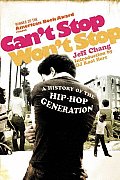 Jeff Chang: First off, congratulations on Rip It Up! It's fantastic work, and more than deserves every accolade that's come down. My formative music years also coincided with the turn of the 80s and Reagan/Thatcher, and—all VH1 kitsch aside—I agree that it's a period that has been easier to parody than take seriously. I love the breadth of the groups you cover in the book, from Adam and the Ants to PiL to the Slits; it resonates with my own musical explorations during my teens. I remember that reggae, Hawaiian music, and hip-hop were the sounds that I searched out, and that post-punk and new wave was what I was primarily reading about, in magazines like Rolling Stone, Musician, Trouser Press, and the occasional NME and Melody Maker that made it to my shores in the Pacific.
How in the world do you begin to capture this all under one big "post-punk" umbrella? And do you think it's possible that the diversity of that period sets us up for the proliferation of micro-pop genres and niches these days? And how do you think the profusion of styles you encountered in your teens informed your views of music and culture?
Simon Reynolds: Thanks, Jeff, and big up ya chest for Can't Stop, Won't Stop, a colossal achievement—literally colossal (more on that later!). I did tons of research for Rip It Up but I can't imagine what it was like for you embarking on a project that cuts across three decades of not just musical but social and political history. Perhaps you could talk a bit about how you approached such a huge undertaking, how long it took to research, and also the difficulty of deciding what to leave out.
On the subject of postpunk as umbrella term, the way I loosely defined postpunk was music that had been catalysed by punk but didn't sound like punk rock in the classic sense of Pistols/Clash/Ramones. Bands that wouldn't have existed without the spur of punk giving them the confidence to do it themselves, but who felt the true spirit of punk was not to repeat but to experiment and keep moving. The big exception to "catalysed by punk"—which requires a second-level definition of postpunk—is bands who happened to be in existence before punk happened; e.g. Devo, Cabaret Voltaire, Pere Ubu, the Residents. Some of them had been around many years, but only found a substantial audience because punk opened things up. That opening-up had several levels. Firstly, punk created an audience with an appetite for more challenging music. It shook up the major labels, and made them more likely to sign edgy bands or take risks—the chase to sign Devo as "the next Sex Pistols" is one example—for fear of getting left behind. Punk also catalysed the independent label movement, which provided a distribution network for weirdo music that would otherwise have just subsisted on a home-taping/mail-order level, and also a cultural context in which risk-taking music "signified" and found a proper reception. So overall, I'd define postpunk not as a genre of music but rather as a possibility space in which a host of new genres and scenes formed.
That open-endedness naturally lent itself towards diversity and fragmentation. So as the postpunk era proceeds, by the time we get near the end of the period I'm covering (1983-84) the distance between things is starting to get vast. There's a gulf between Goth and the glossy New Pop stuff, between synthpop and the return-to-guitars of those bands I've dubbed "glory boys" (Echo & the Bunnymen, U2, etc). Everything is scattering and following its own divergent and often antithetical path. But the point of origin—the mythic site of lost unity—is punk. That's the ignition point, the Big Bang. Even Duran Duran, who seem like the ultimate "like punk never happened" band, had started out wanting to combine Sex Pistols' "God Save the Queen" and Chic's "Le Freak."
I don't know if postpunk is the beginning of the modern age of genre fragmentation, though, because the early Seventies was like that, in a way: a diverse but diffuse era that people still have some difficulty getting a grip on. It's more like rock history has alternated between periods of unity (the mid-to-late Sixties; punk; to a lesser extent grunge and early rave) and phases when consensus disintegrates and the tribes scatter. These periods of drift and diaspora tend to get seen unfairly as troughs or wastelands, which was one reason it was enticing (but also challenging) to attempt to write about the punk "aftermath" as both a unified epoch and a surge-phase.
Continue reading Jeff Chang & Simon Reynolds, pt. 1
June 05, 2006
Jessica Abel & Alison Bechdel, pt. 1
Perhaps you noticed yesterday's enthusiastic NYTBR review of La Perdida, the new graphic novel by Jessica Abel. It also got a starred review from Publishers Weekly, as did Fun Home, the graphic memoir by veteran cartoonist Alison Bechdel. The new ways that these two women are taking the comics medium and using it as a vehicle for personal expression convinced me that getting them talking to each other would yield a lot of insights for readers...and as their conversation unfolds, I hope you'll believe I was right.
 Alison Bechdel: La Perdida originally came out in serialized form over a period of four years. As a comic strip artist, I’m really interested in the aesthetics of serial publication, so I’m wondering things like, how tightly did you have the whole story mapped out before you started drawing? How much did you make up as you went along? Did you paint yourself into any interesting corners? Was serial publication an economic necessity? Did reader response influence the development of the plot at all? How did the constraint of the serial volumes, lengthwise, effect the structure of your larger dramatic arc? And finally, were there any major plot changes between the serialized version and the graphic novel?
Jessica Abel: One thing I've figured out as I learn to teach art students to make comics is that my own method of making comics is at least unteachable, if not just plain unadvisable. There's a huge proportion of improv that goes into it, even in the short stories, though of course, they're really short.
Basically, I started with a vague idea for a scene (the hallucinatory scene at the end of chapter one). As I thought about who might be having that vision, and why, I came up with Carla, then Harry. I spent a long time developing and thinking about the characters and what bound them together, which led me to come up with a lot of the major plot points. I have to admit, how I got from that first idea to the whole arc is sort of lost in the mists of time. But as far as I remember, I worked out the whole story arc, then sat down and started writing chapter one. I probably started drawing it before I even finished writing it, knowing me. There were a number of directions I intended to follow to resolve the events at the end (no spoilers!) that I ended up rejecting as too byzantine or just not necessary. For example, the scene in chapter one where Carla and Harry go to meet a journalist—I had the idea that she would be instrumental later on, that the drama would somehow play itself out in the newspaper as well. But in the end that idea was just too unwieldy, and I simply left that early scene in to give some sense on context. It's one of the few based on actual events; I met a journalist like her early in my time in Mexico, and she said similar things about living in Mexico. A lot more of them, actually.
But anyway, I dived right in before I'd nailed down all the details of the story, in order to motivate myself to move forward on the book. The thing this method had in common with my earlier short stories was the fact that I had to fit the chapter chunks into multiples of 8 pages, due to the way books are printed. In fact, it's better/easier to print books in multiples of 16 pages, which is what I did in this case. So all along, as I'm writing, then thumbnailing the pages, then penciling and inking, I'm thinking: this has got to come out at 44 pages (to account for the title page, indicia, etc.). I'm massaging, projecting ahead, trying to shorten or lengthen…OK, seriously? I never have to lengthen. Only shorten. But anyway, it's a strange process that I trained myself into early on, a version of what you have to do with the space for your strip, but of course a lot longer, so a lot more can happen (i.e. go wrong) in the middle. Though maybe that's presumptuous of me. I think working in strip form—such tiny chunks of narrative—must be incredibly demanding.
Overall, I fit chapters one through four into 44- or 45-page chunks, but I still missed my length by about 60 pages (all of chapter five). I expected to finish in four 48-page books. So I obviously didn't know what I was doing too clearly.
Continue reading Jessica Abel & Alison Bechdel, pt. 1
March 18, 2006
Patrick Ryan & Stephen Harrigan
When Patrick Ryan's Send Me and Stephen Harrigan's Challenger Park showed up in my mailbox within a few days of each other, I found their thematic correlations so intruiging that I immediately started thinking about how I could get the two authors talking to each other.
 Patrick Ryan: Reading Challenger Park was like stepping through a looking glass into a parallel universe. I grew up on Merritt Island, Florida, always in the vicinity of astronauts and launches, and have written fiction about characters in the shadows of that whole operation (either as employees with less-than-glamorous jobs or as local residents who just happen to have Saturn rockets and space shuttles climbing into sky over their shoulder while they're, say, mowing the lawn). Your novel is about actual astronauts, so I felt as if I were reading the story of what was happening on the other side of the glass, so to speak. It was fascinating for me, and interesting that the challenges your characters face are, in some ways, very similar to ones mine face.
Can you talk a little about how the themes of the book may or may not have affected the writing? I could argue that some of Challenger Park's themes are regret, self-disappointment, and certainly isolation. Also, there's the idea of "Ground Control" and what that means. Many of your main characters are in various states of being "ungrounded" (sometimes literally). Do you feel that these themes helped shaped the book as you were conceiving it (before the actual writing), or that they emerged as you began producing pages? I guess another way to ask that is, did you see the themes on your way in, or on your way out?
Stephen Harrigan: I knew I wanted to write a book about a woman astronaut caught between the pull of her own ambitions and the responsibility she feels toward those who depend upon her on earth, so I guess the theme was there from the beginning, though I didn't announce it to myself as such. The word "theme" has always uncomfortably reminded me of stultifying classes in high school or college, in which a novel or a poem or a story was presented as something that needed decoding. If you could discover the theme, you could understand a piece of writing in some approved way. But I'd be lying if I didn't admit that I worried and fretted over the meaning of this book all the way through. I have a day job as a screenwriter, and because screenplays are such relentlessly efficient narrative machines I've fallen into the habit over the years of constantly asking myself questions as I write: what is this book or movie really about? What is it that the character really wants? What is in his or her way? Those sorts of questions can be cripplingly didactic to a writer early in his career, when a certain amount of flailing about is probably necessary and healthy, but later on, when you've learned a few things about your limitations, it can be liberating. If you keep posing the right questions to yourself, you can begin to shape the story with a clear purpose in mind. You can see what's crucial to the story, and what you don't need to write after all.
Send Me is labelled as "fiction" on the jacket rather than, as is usually the case, "stories" or "a novel." At first I thought this was just some sort of marketing strategy on the publisher's part, but after I read four or five of the pieces and began to get an idea of how they fit together, I soon realized that the book was earning its unusual categorization. It's not a collection of short stories, even though each of the chapters has a kind of stand-alone artistry, and it's not a novel, even though the book has by the end the force of a sustained narrative. I'm such a literal-minded, one-chapter-after-the-next sort of writer I can't imagine being able to tell a story this way, and I'm filled with admiration for how beautifully you've made this book work. The way you've put it together—continually juxtaposing the past against the future, putting bright scenes of family togetherness in one chapter, then leaping ahead to expose the chilling dissolution of that family in the next—ensures that the reader is always following the fortunes of these people with a haunted awareness of what they are trying to escape from and what is in store for them. So to finally get to my question: Were you consciously focusing on the structure of this book all the way through and writing to achieve a specific overall effect, or did you write the various pieces as they occurred to you and then felicitously found the perfect order in which to link them?
Patrick Ryan: I think I would have the same reaction you did to seeing the moniker "fiction" on the cover (wondering if the book was simply unwilling to commit to being either a novel or a story collection), and I'm delighted that you found an overall sustaining sense of narrative in the book. Calling the book simply "fiction" was actually my idea, and I was surprised and very happy that my editor saw why I wanted to use the term and that she was in favor of it. My earliest conception of the book was of an interwoven series of narratives about a family—six main characters—whose lives constantly intercept and profoundly affect one another. I saw it as a book that would have a half-dozen overlapping arcs, as opposed to one dominant arc that a reader would normally expect from a novel. There were storylines I outlined and never wrote, of course, and some I tried to write and dropped. I played around with the order the parts might be arranged in, but I always wanted them to be presented out of chronological sequence.
To answer your question more succinctly, I did consciously focus on the structure of the book from the first day I started taking notes on it; I just wasn't sure where all the pieces would land. Some of them, once they were written and revised, clearly announced themselves as wanting to be placed near the beginning or near the end or—as was the case with the longest piece, "Woman in a Fan Chair"—smack dap in the middle of the book. And some of the pieces I moved here and there to see how it would affect the
overall narrative.
Continue reading Patrick Ryan & Stephen Harrigan
February 17, 2006
Mark Lytle & Philip Jenkins
When I saw that Oxford University Press had published Mark Lytle's America's Uncivil Wars: The Sixties Era from Elvis to the Fall of Richard Nixon a few months ago, as well as Philip Jenkins's just-released Decade of Nightmares: The End of the Sixties and the Making of Eighties America, I knew I'd found two men who would have something to say to each other. (Of course, I've been thinking about the era they write about a lot, considering that my own book overlaps them both...and as Jenkins notes on the OUP blog, that era is quite relevant to our contemporary situation.)
 Mark Lytle: You make a compelling case that by promoting issues such as drug abuse (especially crack), sexual predators, pornography, and family values, the conservatives addressed deeply felt fears among Americans, including once loyal New Deal Democrats. These attacks on crime and moral decay paid dividends at the polls as Reagan swept into the White House and Republicans made gains in Congress. So in that sense the moral crusade paid major political dividends—it was good politics. But was it not also in a sense tilting at windmills?
We've turned prisons and incarceration into a major industry and a form of social welfare for rural communities. The DEA throws a paper curtain across our borders without any evident impact on drugs other than maintaining high levels of profitability for dealers. As you put it, "Tthrough the early 1980s, there was a staggering disconnect between the portrayal of menaces and what could plausibly be seen as their substances." In that light, could we not argue that the major legacy of this era, while good politics, was bad public policy?
Philip Jenkins: Many of the worst and most troubling aspects of domestic policy today do indeed have their roots in what I've called the decade of nightmares between 1976 and 1986 —that is, in the Carter years as well as the Reagan era. You rightly cite the boom in prisons, the drug war, and the demonization of many types of offenders. And in tracing the history of these policy distortions, I would find it difficult to draw a line between Republicans and Democrats: the Clinton presidency yielded nothing to the Reagan times in its ultra-hard line on these issues. The only defense that one could make of these trends is that things probably had gone too far in the ultra-liberal direction in the mid-1970s, when people were naive about the harm that drugs could cause, and when attitudes towards child abuse had become scandalously negligent.
But there must be a happy medium between the two extremes. I would love to see a modern political leader stand up and challenge the orthodoxies of post-1980s criminal justice, reasserting for instance the value of non-custodial alternatives to prison, and making the significant reduction of the prison population a major policy goal. Someone should also be telling the drug enforcement authorities where to get off in terms of classifying chemicals, so that substances with real medical value could and should be used appropriately, whether that is for pain control or for psychiatric purposes. Someone needs to challenge absolute prohibitionism—and who knows, maybe such a campaign could bring libertarian Republicans together with liberal Democrats.
One of the great strengths of America's Uncivil Wars is how you root the events and controversies of "the sixties" (that is, roughly, the tumultuous era from 1963-74) in the earlier decade, and you convincingly show the longer-term continuities. Looking at the broader span of American history, many would argue that periods of intense social/cultural/political/religious/sexual activism actually recur with some regularity, and the 1960s were only one recent manifestation. I think for instance of the 1840s, the years around 1915, and the late 1940s. (In fact, maybe historians shouldn't be trying to explain the upheavals, but should rather be puzzling over what makes the intervening years so unnaturally tranquil!) But here's a question: The more we look at the 1960s in historical context, should we be challenging the common impression that they were an era of unparalleled utopianism and creativity? Was the era really that different or novel?
Mark Lytle: I would say that the era was novel because of the scope of public unrest, but that its utopianism and creativity were certainly not unprecedented or unparalleled. Indeed, I would argue that in the arts the 1950s were a more fruitful era. In some ways the politicizing of the arts in the 1960s had the same inhibiting effect on creativity as was evident in the 1930s. As you suggest, the 1960s certainly manifested much of the revivalist and reformist spirit of the 1840s and even the Great Awakening in the 18th century. Sixties movements we think of as primarily secular—The New Left and Environmentalism come to mind—evidenced significant religiosity. Religious leaders drove the early phases of civil rights and their connection to the church gave the movement much of its legitimacy. And there can be no question that much of the counterculture reflected a rejection of American materialism and a quest for transcendent spiritual values.
So what was novel about the Sixties? I think the war in Vietnam gave activists a sense of moral imperative that added exceptional numbers and intensity to protest. The war factor was missing in the earlier reform eras. Media would add a second factor. Through television, events of the era had greater immediacy and protestors could send their message to a far wider public. The varieties and intensity of protest distinguish the 1960s, but the era certainly echoes earlier eras of protest and reform.
Another round of questions follows!
Continue reading Mark Lytle & Philip Jenkins
January 04, 2006
Fiona Rosenbloom & Ruth Andrew Ellenson, pt. 1
I was a fan of The Modern Jewish Girl's Guide to Guilt even before I met the anthology's editor, Ruth Andrew Ellenson, at a reading at Mo Pitkin's last fall, so when Fiona Rosenbloom's YA novel, You Are SO Not Invited to My Bat Mitzvah!, landed in my review pile, I emailed Ruthie (we'd been writing back and forth by then, and bonded over lunch with Mrs. Beatrice, who was equally charmed) and told her I'd found a perfect Author2Author partner. Luckily, Fiona was up for it, too, and here's the first half of their conversation.
Fiona Rosenbloom: There are a lot of really interesting things revealed in this anthology, but the most interesting, to me at least, is revealed in the introduction. Judaism is passed along matrilineal lines, and while your father is a rabbi, your mother converted to Judaism, making you, the editor of this Jewish anthology of built, technically not Jewish. So, before we get into Guilt, I thought I'd ask you if your definition of Judaism runs counter to this belief. How do you identify with Judaism? And do you even subscribe to the matrilineal blood-line belief? Is Judaism, for you, a personal choice?
Ruth Andrew Ellenson: It's a interesting question and one I've dealt with in various ways. I'm probably in a extremely small club: rabbi's daughters who are also Daughters of the American Revolution.
Just to clarify, I am Jewish because not only did my mother convert, my father actually had me converted as an infant in an ultra Orthodox ceremony. So hallachicly, according to Jewish law, I'm as kosher as they come. I grew up in a very rich intellectual Jewish world, where identity was discussed frequently and it never entered into the conversation that I wasn't part of that world. To answer your question directly: No, I never felt Judaism was a choice; it was absolutely, definitively who I was and am. I was also lucky to spend much of childhood around the Havurah movement of the 1970s, which emphasized new ways to approach Judaism and Jewish identity. When my parents were married, I think my mother's identity as a convert was seen an exotic. Here was a former beauty queen with a Southern accent who had lived on a kibbutz and spoke Hebrew. Not too many of those on the Upper West Side.
I think what that legacy produced in me was an openness to Jewish identities that don't fit the mold, that don't perfectly relfect the community as it wishes to be. Perhaps I'm especially open to ambivalence and complexity in religious identity because I was raised with such an unusual background where both my Christian and Jewish heritages were known to me and appreciated, but I grew up in such a Jewish milieu there was no question as to who I was. As I mention in the book, I never felt more Jewish than when I went with my grandmother to church.You capture the horrible, hilarious tone of junior high school girls perfectly. One thing I loved about the book was how genuinely moving and funny it was. Was it hard for you to go back (both psychologically and as writer) to that age? Did you hang out at the mall and eavesdrop or was it something that came back to you all too easily? Was your Bat Mitzvah experience at all like Stacy's?
Fiona Rosenbloom: I'm not sure quite what it says about me that it was not difficult accessing my emotional self at age thirteen. Perhaps it was scarring enough, damaging enough, to have etched its way permanently into my psyche that "going back" wasn't necessary. Much to my surprise, it was all still here. I do have the added bonus of having a very young sibling, and nieces, who helped me with all the pop culture references and dressed my characters for me, but emotionally, I didn't have to go far.
I didn't go to any malls or Bat Mitzvahs while writing this book. While present day culture is completely represented here, it all came last: mall life, lingo, clothing... To me it was the least important (although, obviously, these features are the most important to the kids who write me or ask me about Stacy's popularity). The experience of changing from a child into a young adult is a universal one, regardless of culture or country. The biological and mental changes are threaded through each of us and connect us all. And it was that experience I wanted to capture most, these were the felt moments I wanted to resonate. Sure, not going to malls or Bat Mitzvahs made capturing certain details infinitely harder, but I like to suffer. I'm Jewish.
November 17, 2005
The Goldberg Brothers, pt. 1
Here's an Author2Author twist: brothers! Lee Goldberg and Tod Goldberg are actually appearing together tonight at the Santa Monica Barnes & Noble, and to celebrate I'm finally getting it together to run the battery of questions and answers they sent me, oh, months ago. (Really, I am finally getting the hang of writing two blogs, honest I am...)
 Lee: You broke into publishing by writing short stories (which have been collected in your new book Simplify), but would you recommend other writers take the same route? From everything I've heard, the short story market is supposedly dead...unless you can live by eating the free issues the literary journals offer witers as payment. (Anyone have a good recipe for Journals Au Gratin?)
Tod: Everyone has their own route, of course, but for me writing short stories before attempting to write my first novel just sort of made sense in an artistic way and in a self aggrandizing way. When I really began to take writing seriously, which is to say after I got out of college and was able to recognize how exceptionally awful the novel I thought I was writing in my last creative writing course at Harvard (and by Harvard, I mean: Cal State Northridge) was—the premise had something to do with a semi-haunted house in Maine, a state I'd never visited, that a (surprise!) college graduate student had volunteered to watch over summer; I never got past page 65, due in no small part to my Kaypro crapping out and the fact that, well, it sucked—short fiction seemed to be the best way for me to hone my skills. It also gave me a strong sense of completion in a fairly short amount of time, which made me feel good.
The short story market is far from dead. There are literally thousands of print journals and magazines and many more online as well, and I'd venture to say that all of the folks getting published by them are likely not of the Zombie-variety. You can't make money, at least not at first, but what you can make is something far more important: a reputation and a publishing history, both of which are quantifiable things in the publishing business. I happen to love short fiction—I love to write it and I love to read it—and when it is done well, I think short fiction is as moving and as important as a novel can be; take Dan Chaon or Mary Yukari Waters, for instance, and you'll find in 5,000 words what often takes other writers 75,000 to achieve.
Lee, in the last two years you've written, what, nine books?—several of which are based on long running TV shows (Diagnosis Murder & Monk). Your latest novel, however, The Man With The Iron-On Badge, is a stand alone mystery. Is it easier to write a stand alone, where you have to establish that character and back story from page one, or do you prefer working with established franchises? In between all that, you and your writing partner also wrote a book on screenwriting—how difficult is it for you to be constantly changing speeds?
Lee: For the last twenty years (My God, am I actually old enough to start a sentence with that?), I have made my living as a TV writer/producer. I spent most of that time…okay, all of it…working on shows that other people created. That's true of most TV writers. You are hired, for the most part, for your ability to articulate someone else's vision and, at the same time, bring your own unique voice to the writing. So I am quite comfortable writing about characters and worlds created by others. I look at my tie-in novels as the publishing equivalent of working on an episodic television series.
That said, I wasn't just a writer on Diagnosis Murder, I was one of the executive producers. Basically, the show was mine. Although I was given the characters, and the world they lived in, I was free to make whatever changes I wanted. They were mine to shape and, as a result, inevitably reflected my own creative choices. Writing about them became no different than writing characters I created myself. And now, as I write the Diagnosis Murder novels, the characters feel very much like my own creation because they have been under my stewardship for so long. I have been living with them, and writing about them, on TV and in print for a decade now.
Monk is different. I’m a freelance writer on the show, contributing individual episodes and working hand-in-hand with the creator/exec producer Andy Breckman. That relationship extends to the books as well, though he has given me the freedom to make the character my own. Andy recognizes that books are different than television and that I need to dig a little deeper than a 44-minute teleplay allows. My Monk is recognizeable as the TV character but, in some ways, he's my own Monk. For one thing, the books are all told first-person from the perspective of Natalie, his assistant, which is bound to give the stories a different feeling than the TV episodes.
The great thing about writing an original novel, not based on any pre-existing characters, is that I am not inheriting anyone else’s choices (good or bad). I'm not stuck with character traits or backgrounds or situations that I don’t like. Obviously, I get more personal satisfaction out of writing an original novel as opposed to a tie-in. But when it comes to the actual writing, the sitting down at the keyboard and telling a story, there is no difference at all. I'm equally invested in the work, personally and creatively, whether it’s a tie-in or an original.
The Man With The Iron-On Badge allowed me to not only write about a character that was close to me, but to also examine the detective genre I've been toiling in for so long. The hero is a guy who learned everything he knows about detecting from watching TV and reading books. He's a human tie-in, so-to-speak, a man who has derived his character from other characters in search of a character of his own (could I possibly have used "character" more in one sentence?). My other original novels, I realize now, also share a similar thematic link…My Gun Has Bullets, Beyond the Beyond, and The Walk also have characters who are influenced by a life-time of watching, and absorbing, TV clichés.
One of the great things about writing original novels, TV shows, tie-ins and non-fiction books is that the variety and diversity of the challenges keeps me fresh. I don't fall into a rut. I like to think that makes me a Writer… as opposed to a TV Writer, or a Mystery Writer or a Tie-In writer.
November 15, 2005
Author2Author: Leo Damrosch & Roger Pearson, pt. 1
When the galleys for Leo Damrosch's Jean-Jacques Rousseau: Restless Genius and Roger Pearson's Voltaire Almighty: A Life in Pursuit of Freedom arrived in my mailbox within days of each other, I knew I had an Author2Author to set up. So I got busy—and while I was making the necessary arrangements, Prof. Damrosch received a nomination for this year's National Book Award in the nonfiction category. I'm glad he was able to take some time during an incredibly hectic month to chat with Prof. Pearson by email, and I'm sure you'll enjoy the results.
 Leo Damrosch: The breach between Voltaire and Rousseau certainly originated in some intemperate remarks of Rousseau's, exacerbated by his public campaign against the theater Voltaire hoped to establish in Calvinist Geneva. But afterwards it does seem that Voltaire worked insidiously against Rousseau behind the scenes, while proclaiming total innocence even to those closest to him. What is your sense of this from Voltaire's point of view?
Roger Pearson: Voltaire regarded theatrical entertainment as having a civilizing effect on actors and spectators alike. He liked to draw on the history of ancient China, Greece and Rome in particular to argue that public theatre, by bringing people together in the shared enjoyment of the 'pure pleasures of the mind', renders human beings more sociable in their dealings, more moderate in their behaviour, and keener in their judgement. Progressive elements in Geneva shared his view, and were pressing for the city fathers to lift their ban. Rousseau tried to persuade the city of his birth not to do so. For him the theatre was emblematic of the insincerity, immorality and taste for show that he found widespread in the society of his time.
In campaigning against Voltaire Rousseau accused him of being an atheist, thereby seeking to alienate moderate (let alone reactionary) Genevan opinion. And yet Voltaire was a deist, as was Rousseau. What caused the breach, however, was not the substance of the charge but its timing. Rousseau's accusation (in his 'Letters written from the Mountain' (1764)) came just at the moment when Voltaire was awaiting a decision from the royal council in France in the case of Jean Calas.
Calas was the Protestant merchant from Toulouse, who in a monstrous miscarriage of justice had been executed for supposedly murdering his own son for wanting to convert to Catholicism. Thanks to Voltaire's extraordinary efforts Louis XV's council had agreed to review the evidence, and the world's first champion of human rights was hopeful that they would clear Calas's name, even if they could not restore the man to life. And Rousseau—whom Voltaire considered a fellow-traveller in the great cause of Enlightenment—chooses this moment not only to accuse Voltaire of being an atheist but also to reveal that he was the anonymous author of the 'Sermon of the Fifty' (1752), a particularly savage onslaught on the Judaeo-Christian religious tradition? Just when Voltaire was trying to get the Establishment to back him? Voltaire never forgave Rousseau for putting his own campaign against the theatre before the posthumous fate of an innocent man. Thereafter he attacked him openly and violently, revealing to the world for the first time what Rousseau had done with his five children and (in Voltaire's view) exposing him as a hypocrite.
Another question and answer follow after the break...
Continue reading Author2Author: Leo Damrosch & Roger Pearson, pt. 1
October 26, 2005
Author2Author: Sarah Willis & Maureen McHugh, pt. 1
I'm afraid that I've been sitting on this transcript of the Author2Author exchange between Maureen McHugh and Sarah Willis for way too long—between going on that festival tour, then trying to relaunch a column as soon as I got back. But enough of my excuses, let's just get right to the dialogue, and discover what makes this pair of writers such a good fit.
 Sarah Willis: I was thinking about how we met at the Cajun Sushi Hamsters (a Cleveland science fiction writer's group), and what a wild experience that was with some 22 members critiquing my first attempt at a novel, a 400-page SF story with a neuropsychiatrist as a narrator. (What was I thinking??) It didn't take me too long to figure out that what I write best is more mainstream, and I left the group and started a writer's group with just a few people that met at my house once a month. I didn't know you very well then, and when you asked to join our group I was both surprised and a little terrified.
You were a real writer with published short stories and an award winning novel, China Mountain Zhang. I had, at that time, published one short story, and was frankly in awe of you. I thought you'd upset the apple cart. You've been in our group, what, thirteen years now? I can't even imagine it without you. So here's the question: Why did you want to be in both writer's groups, and how does a writer's group help you?
Maureen McHugh: Sarah, the fact that you were nervous surprises me. I thought I was writing genre fiction and you were writing the real thing. You had this spare, beautiful way with prose. Funny how we see ourselves versus how others see us. I wasn't at all surprised when you left the Cajun Sushi Hamsters because while they're a great group, they seemed interested in different things than your fiction. I guess I felt as if I had a foot in both camps. I wrote stuff that was ostensibly genre, but I'd studied fiction writing at New York University under writers like Robert Stone, Alyx Kates Shulman and Edmund White.I feel tremendous loyalty to the Hamsters and to the East Side Writers. I guess I'm in two writer's groups because I felt so strongly that I was suspended between genre and non-genre fiction. That was before slipstream was what it is today, before people like Michael Chabon and Suzanna Clarke and Jonathan Lethem were writing across what felt to me to be very difficult barriers. Now I feel as if what the two groups have is not so much genre/non-genre as just different sensibilities. On the rare occasion I've had a story critiqued by both groups, their takes were often extremely different. I don't think one was right and the other wrong, just that they offered different perspectives on the story.
I think writer's groups, like cities and people, have personalities. Now I'd hate to give one up because I genuinely like them both.
August 16, 2005
Author2Author: Chelsea Cain & Susan Kandel, pt. 1
I was so glad when, after I introduced Chelsea Cain and Susan Kandel to each other and arranged for each to receive a copy of the other's novel, their reactions were so positive. Chelsea had this to say about Susan's Not a Girl Detective, in which amateur sleuth Cece Caruso solves a murder intimately connected to the Nancy Drew ouevre: "I loved your book. You have a such a great voice, somehow light-hearted and wicked at the same time." And Susan told Chelsea that her Nancy Drew parody, Confessions of a Teen Sleuth, "was a hoot. I read it in the offices of Dr. Weintraub, orthodonist extraordinaire, waiting for my eleven-year-old daughter to have her braces removed. Within the hour, I had a seventeen year old and her mom enthralled with my explanation that Bess wasn't really fat, that Nancy's mom was actually alive, and that Frank Hardy--well, I don't really want to go there..."
 Chelsea Cain: I suppose that we should start with the obvious: Nancy. I had such a great time re-reading ND books when I was researching for Confessions, and I was amazed at how I had merely to stack a few of the series on a table in a public place and streams of women would materialize all wanting to share memories of the titian-haired detective. (Okay, sometimes it was kind of annoying.) I'm going to go out on a limb and guess that you read a few ND books as a kid? What role (if any) did those books play in your life as a reader/writer? What was your favorite ND book? And what was it like to revisit the books in preparation for Not a Girl Detective?
Susan Kandel: I never read a Nancy Drew book growing up. It feels good to get that off my chest. I came to Nancy Drew through my de-braced daughter. When she was in first grade, we used to sit in the park after school and I'd read her the books, one after another. By the time she was in second grade, Kyra, her little sister, Maud, who'd clamored to join us, and I were all really into the latent humor. We especially liked the names of the crooks. Our favorite was Benny "The Slippery One" Caputi. We somehow conflated him with Thomas O'Malley, Alley Cat, from The Aristocats, but that's another story.
Nancy was always exempt from our jokes. She is the alpha girl every zeta girl wants to be: confident, unflappable, unstoppable, loyal, smart, good. She should make you want to puke, but she doesn't because she makes no pretense of being human: she's a phantasmatic suburban superheroine who can eat pudding twice daily and still turn a mean cartwheel when needed. It's sci-fi for girls. What could be better? My personal favorite is Lilac Inn: it is the classic book, I think. My girls prefer The Double Jinx Mystery, which (sorry) goes for baroque.
Chelsea Cain: My favorite ND book was The Mystery of the Glowing Eye which opens with a helicopter flown by "remote control" crashing into Nancy's backyard. In it is a note from Ned, who has apparently been kidnapped and Nancy has to spend the rest of the book tracking him down. It's one of the yellow hardbacks from the 1970s, an era universally considered the low point of the series, but the interior illustrations of Nancy in bell bottoms are to die for. (Cece would approve.) Strangely, the whole remote-control helicopter crashing bit did not strike me as odd at all as a kid.
It is sci-fi for girls, isn't it? Having written a parody of the books, I've been a little amazed at what, uh, passion some grown-up women still feel for the intrepid Ms. Drew. (The Chums in your book really rang true to me.) They are very defensive of her character. I've heard the phrase "that is never how Nancy's life would have turned out," so many times I've wanted to bludgeon strangers with a magnifying glass.
Tomorrow: More tales of Nancy fandom!
August 09, 2005
Author2Author: Amanda Filipacchi &
Adrienne Brodeur, pt. 1
I met Amanda Filipacchi at her book party a few months ago, and soon thereafter she expressed her enthusiasm for the Author2Author features here and wanted to know if she could do one. Sure, I said, so she lined up her friend and fellow novelist, Adrienne Brodeur (whose name Poets & Writers fans will recognize from an article on what happens when editors write), and they set about querying each other about their novels: Love Creeps for Amanda, Man Camp for Adrienne.
 Amanda Filipacchi: I found Man Camp a lot of fun to read, which you may find surprising when you hear I'm someone who gets pissed when my mother asks my brother to sit at the head of the table because he's a man, or asks me to do the dishes and asks him to do nothing except occasionally take down the trash or other manly activities. I can't stand those stereotypical gender roles and I can tell you they've caused many fights in our family. Even at other people's houses, or at dinner parties, the sight of all the women bustling about, clearing the table, while the men just sit there and talk fills me with a kind of sad nausea. In your book, I found it very interesting to see how you explore the opposite point of view. Your female protagonists want men to be more manly (though I couldn't help noticing with glee that in one scene these women do get irritated when the men don't help clear the table). You describe that point of view very persuasively and I found myself able to see the appeal of a manly man (albeit only for brief instants, because it goes against my nature). When you wrote this novel, did you wonder whether you might be taking a possibly unpopular stance on this subject, and if yes, did that worry you?
Adrienne Brodeur: I love this question because, believe it or not, my head was nodding in agreement throughout, especially during your description of "getting pissed" at family gatherings. I've felt a similar fury over the years watching my brother push back from the dinner table, arms often behind his head, as he waits for some eager girlfriend (or worse yet, my mother or me) to clear and wash his dishes. Argh!
But anyone who really reads Man Camp, I hope will recognize the fun I poke at all gender stereotypes. The title of this book is meant to be outrageous. Hell, the concept, if taken seriously, is downright offensive. But therein lies the twist: it is the urban men, initially ridiculed for their lack of skill in the area of manly arts, who end up thriving at Man Camp, the dairy farm where they are sent to go through masculinity boot camp. And it is Lucy and Martha, two completely competent New York women, who struggle and fail when expected to adopt more traditional gender roles. Moreover, Cooper, the man who the women initially idolize as the perfect male and who is the main "counselor" at Man Camp, is discovered to have chinks in his macho armor. Precisely, it is his brand of conventional machismo (doing things the way they've always been done, not discussing problems or feelings, etc) that seems to be undercutting both his financial and romantic success. In the end, the New York men with their new culture of masculinity are the ones who save the day.
Obviously, Man Camp takes a rather light-hearted look at the subject of gender roles, making its points through humor, and while I don't feel defensive about it, I've been surprised by the reaction that somehow I must be an advocate for days gone by. Hardly! Man Camp sets out to tease women every bit as much as men about the seemingly ubiquitous desire to have it all in a mate, when ironically, if there is one truth about love, it is that it requires compromise on everyone's part. And while I'm sure this is unnecessary to state, like all women of our generation, I owe a huge debt to the feminist movement. Over the course of my professional career, I've had the opportunity to be chief of staff in a political office, to found and run an award-winning fiction magazine (Zoetrope: All-Story), and now, to write and publish a novel.
July 19, 2005
Author2Author: Susann Cokal and René Steinke, pt. 1
This spring, I attended events for René Steinke and Susann Cokal, and it had occurred to me early on that getting the two authors together to talk about their flamboyant female protagonists would make for an interesting conversation. Today, René reveals how she decided to center Holy Skirts around Baroness Elsa von Freytag-Loringhoven, a real-life fixture on Manhattan's early 20th-century art scene. You could say that she was a Factory Girl before her time, but I prefer to think of her as the trailblazer without whom the Factory wouldn't quite have come about...at least not the same way. (Tomorrow, we'll undertake a similar exploration of the fictional world of Cokal's Breath and Bones.)
 Susann Cokal: I loved your character of the Baroness--and you obviously love her too. I gather the historical record about the original Baroness is somewhat sketchy, so I'd be interested to know how you connected with her deeply enough to begin your research and your recreation of a life for her. When you first encountered her, what about her sparked your writerly passions? And since she's such a dramatic, larger-than-life character, could you describe the process of shaping her into someone with whom a wide readership can connect emotionally as well?
René Steinke: I was actually attracted to the Baroness partly because of the scant sources--the holes in what's known about the Baroness seemed perfect for fiction, practically invitations to invent. But I began to really feel for her and get a better sense of her character when I read the unfinished autobiography, and the correspondence (there is quite a bit of this) in the papers preserved at the University of Maryland.
I first discovered her when I was writing about William Carlos Williams and wanted to find what his contemporaries said about his book of poems, Kora in Hell. I came across a review in the form of a prose poem (in The Little Review) which attacked his fashion sense, his virility, his American-ness, his marriage, and incidentally, his poems. This was written by the Baroness Elsa von Freytag-Loringhoven. I had never seen anything like this; in that time, it was highly unusual for a female to criticize a male poet so boisterously. I was curious, so I did a little more digging, and discovered her outrageous style of dress, the birdcage necklace, the dress with a flashing taillight, and then I was really hooked. I loved the idea of a truly modern female aesthetic, which she was exploring, and the more I found out, the more excited I became. I couldn't believe no one had ever written about the Baroness before.
She was an outlandish, sometimes self-destructive character, though, and sometimes frustrated and disappointed even her close friends. I'm interested in finding the humanity in characters like her, who many would simply dismiss as "crazy." So I tried to reveal that humanity, her vulnerabilities and desires, as vibrantly as I could. And in the novel, her friends do criticize her--so that gave me a way to show several sides of her.
July 12, 2005
Author2Author: Andrew Winston & Adam Langer, pt. 1
How does an Author2Author conversation come together? Sometimes it's a matter of pairing writers by their chosen genres. Sometimes it's because they share a publisher as well as certain thematic concerns, making it that much easier to align their schedules. This week, the unifying factor is location, location, location. Andrew Winston's Looped and Adam Langer's Crossing California both take place in Chicago, though they're set decades apart. The conversation begins with the earlier of the two settings, as we temporarily jump twenty-five years into the past...
 Andrew Winston: I am curious about your choice to set Crossing California in 1979-1980. What did the setting allow you to do that you could not have done setting the book in contemporary Chicago? Did you feel constrained by it in any way? Was it important to have access to elements of your own youth? What was most compelling about that material? (Please tell me that--à la Larry Rovner's Rovner!--you once formed a band called Langer!)
Adam Langer: Aside from having read Looped, I don't recall all that much about your background, so I don't know if you're a lifelong Chicagoan, older than me, younger than me, or about the same age, so it's hard to say how our experiences of Chicago might differ. But, to me, the most interesting period in contemporary Chicago history is the period between the Daleys--after Richard J. died and before Richard M. took over--the period that I treat in both Crossing California and my forthcoming book The Washington Years.
Aside from being the time in which I came of age, it was a time of great political upheaval and unpredictability when, as a teenager, I was actually fascinated to read about local politics. There were great villains and heroes: "Fast Eddie" Vrdolyak, "Calamity Jane" Byrne, and, of course, the late, great mayor Harold Washington. I spent my summers in high school and college working for local papers and radio stations, where I would learn of the so-called "Council Wars" on a daily basis--researching Harold Washington for Chicago magazine, writing about gangbangers for the neighborhood Lerner newspapers, rewriting wire copy for WXRT News and WBBM Newsradio 78. Although I don't live in Chicago anymore, I do still read the Tribune, the Sun-Times, and the Reader online, and nothing seems to come close to that heady experience.
What interests me about the period of 1979 to 1981, when Crossing California is set is that as it represented a time of transition in Chicago, it was also a time of transition in the country, the fast move from the Carter '70s to the Reagan '80s. And, of course, that shift does have certain resonances with the present day. I find it fascinating how national crisis always seems to bring America together then split it apart. I remember a sense of unity during the Iranian hostage crisis--yellow ribbons around the trees of West Rogers Park, everyone gathering to watch Ted Koppel and Nightline--followed unfortunately by a period of greed, solipsism, and xenophobia. Sounds familiar.
That said, I have to confess to a certain lack of intentionality in terms of how Crossing California came to be. I know there are many writers who choose to write about a particular historical period in order to comment on the present day; Arthur Miller's The Crucible comes to mind. Also, when I was recently in Chicago to do a reading I caught a matinee of a play at Steppenwolf called Lost Land which commented on contemporary geopolitical conflict through the prism of early 20th-century Hungary. My style of writing is, for better or worse, much more serendipitous or seat-of-the-pants (kind of like this response I'm writing). I tend not to outline when I write, and I only knew Crossing California was set in Chicago when I typed the words "California Avenue," only knew what period about which I was writing when I typed the words "It was 1979." Which sounds like hocus-pocus when I think about it, but that's pretty much how it happened; when I outline, I lose interest, but when I don't know what's happening next, I keep writing to find out. So however many parallels I find between the lives of the characters in 1979 and our lives here in 2005, their existence is either coincidental or subconscious. I found the tight structure of the 444 days of the Iranian hostage crisis more liberating than constraining actually.
And I do have to say that it certainly was convenient for the young characters' ages to correspond to my own, for their experiences to mirror some of my own experiences--defending the Ayatollah before a nonplussed audience of 7th graders, delivering a purportedly erudite speech at a bar mitzvah, performing on kids' shows on NPR, crossing California Avenue every day to get to and from school. I regret to say, however, that I never did perform in a band called Langer! or anything else. I have written a bunch of crappy songs that I've never shared with anyone except my dog and, though I toyed with the idea of recording a demo to go along with the book, I chickened out and decided that the book should stand on its own.
July 05, 2005
Author2Author: Kevin Guilfoile & Tom Morris, pt. 1
Longtime readers may recall that I shared a college class with Kevin Guilfoile, the author of the quasi-futuristic thriller Cast of Shadows. When he and I were thinking about who we might convince to do an Author2Author with him, we turned to a former Notre Dame icon with whom both of us were familiar: former philosophy professor Tom Morris. Kevin actually got to study under Tom; I was routed into another class, but I heard about his guitar-wielding pedagogical technique all the same. Tom eventually left academia to work as a corporate advisor, but he still keeps his hand with the books--his most recent work is as the co-editor (with his son, Matt) of Superheroes and Philosophy, an anthology that combines insights from contemporary philosophers and comic book creators into the themes and concerns underlying some of today's leading comics titles. Because Kevin's novel is also a blend of pop culture tropes and philosophical reflection, the three of us figured there'd be plenty of interesting things to talk about...I hope you'll agree.
 Kevin Guilfoile: In the terrific first essay of Superheroes and Philosophy, DC Comics' Mark Waid describes the task of coming up with a more psychologically complex Superman for the 21st century, and his deliberations are fascinating. How was Superman affected by the knowledge that his home planet and his family had been destroyed? How was he influenced by the parenting style of Jonathan and Martha Kent? What about Kryptonian nature vs. human nurture? Maslow's Hierarchy of Needs?
But isn't there something of a conflict in these stories (in all modern stories, I think, but especially in comic book myths) between philosophy and psychology? Superman, after all, is a classic existential protagonist: It is not his extraordinary powers that make him a superhero, but his extraordinary choice--against great temptation--to use these powers for good. Hasn't the example of Superman always been that the person we become is a choice? That, even though my subconscious substitutes food for affection, I refuse to eat that cupcake because the person I choose to be is two belt notches thinner? (The Kierkegaard Diet Plan! Eat that, Atkins!) If we replace free will with post-Freudian analysis, Superman becomes a more nuanced character, but is he still a real superhero to us?
Tom Morris: The question you raise is a fascinating one. Philosophy and psychology can sometimes pull in opposite directions. Of course, what we now call psychology was once just a part of what was broadly known as "moral philosophy"--a complete exploration of human nature and the human condition--as distinct from "natural philosophy," which became physics, chemistry, biology and the various other "natural sciences. With the disciplines as they exist now, I think of psychology as a study into the functioning of the mind, as well as an investigation into the origins of human behavior, and I view philosophy as a more general pursuit of wisdom about the world, both theoretical and practical.
Superman has long been seen as a fairly one dimensional character. Despite his remarkable birth on another planet, and the dramatic details of how he got to earth to be raised by a farm family in Kansas, he has often been thought of as "plain vanilla," "emotionally bland," or "the Big Blue Boy Scout." He just seems to be this completely altruistic individual who uses all his amazing power to save and defend others for no reward greater than the sense of an important job well done. That's exciting to most kids, but unrealistic to many adults.
By contrast, so many of the other classic superheroes are clearly conflicted and psychologically complex characters. Most superhero stories begin with an accident or tragedy that changes the protagonist forever, launching him into a career of heroic acts in service to others. And it's clear in many of the stories that these traumatic origins have complex psychological consequences (see Peter Parker/Spider-Man for a classic example).
Superman never saw his parents die or his home world destroyed. The tragedy of his origin story was always at a psychological remove from his adult memories, personality, and mindset. But Mark Waid was sure there was more to Superman than has been explored in the past. So he set out to plumb the depths of what it would mean to know that you're an alien living on a foreign world, raised as one of us but not really one of us. What would his psychological needs be? How would they affect his choices to do good and serve as a superhero? Waid wanted to introduce more complexity into the character and, in our book, articulates for the first time exactly the philosophy and psychology behind the innovations in his recent and now famous graphic novel Superman: Birthright.
Continue reading Author2Author: Kevin Guilfoile & Tom Morris, pt. 1
June 29, 2005
Author2Author: Bruce Bauman & Joy Nicholson, pt. 1
Last month, Joy Nicholson recommended Bruce Bauman's And the Word Was to readers of this blog. Bauman got in touch with her afterwards, they got on famously, and, well, here they are talking not just about his book but her new novel, The Road to Esmeralda. (As for that initial recommendation, Joy's clearly onto something; Susan Henderson recently dropped in on MoorishGirl's blog to deliver similar praise.)
 Bruce Bauman: Did you know the ending of The Road To Esmeralda when you started? Because I see similarities in how both your books end with the deaths of certain characters, the horrible position of the main character in each book who is left alive, and of one character, each of whom is, in my mind, fairly evil--though one has more complexity than the other--who escapes rather unscathed despite their horrendous behavior.
Joy Nicholson: I'm not sure if it's a curse or a blessing to be alive? We take it for granted that 'living' is a must--worthy of fighting for with every last drop of anguish--but we don't know if that's a true statement, or just a statement based on wishful thinking or even commercial greed. Life is attachment, and suffering--as well as moments of joy. For instance, Jim, the brother in The Tribes of Palos Verdes: What else should he have done except kill himself? His psyche had been battered, possibly beyond repair, by the woman who could have protected him--and his life would have been one long bout of pain (some would say 'learning') afterward. Phil, the father in Tribes, escapes unscathed and relatively unpained--but how much will his life change? Not much, I'd suspect. His life will be an eternal earthly hell--chasing after women, fame, material objects--never satisfied, always looking for the 'next validation.'
In Esmeralda, Sarah's curse of feeling the world's pain and inequity will die with her; horribly, perhaps, but at least it will be over. Nick's fatal passivity will live on with him--and his, when it comes, will be the death of ten thousand mental cuts. Nick will have a long time to reflect--and unlike Phil, he won't have alcohol and sexual distractions to get him through. And Medina is alive at the end of Tribes, yes, but what has she learned? To persist? Does that really matter?
June 21, 2005
Author2Author: Martha O'Connor & Colleen Curran, pt. 1
When Whores on the Hill and The Bitch Posse, two novels that both feature teen girl trios getting into big trouble, showed up in my mailbox on consecutive days, I figured the gods of parcel delivery were trying to send me a signal about how I should be scheduling my website. So I sent word out to Colleen Curran and Martha O'Connor, and once the three of us had sorted through everybody's tour schedules--well, okay, I'm not on tour yet--the conversation got underway...
 Martha O'Connor: The teenaged girls in both The Bitch Posse and Whores on the Hill cultivate badass, take-on-the-world images, but scratch the surface and one finds heartbreaking vulnerabilities. In your novel, Astrid seems the toughest of all. What about that image draws Juli and Thisbe to her? What's really going on beneath Astrid's tough outer shell? And finally, in your opinion, how does toughness relate to vulnerability, not just in Astrid but in all three "Whores on the Hill"?
Colleen Curran: I grew up in the Midwest during the late 1980s and early '90s. Growing up, all the super cool girls were badasses. At least, in my estimation. These were the girls who listened to the Violent Femmes, the Smiths, the Cure, the Cramps, PiL, the Dead Kennedys, Siouxsie and the Banshees, etc. My friends and I thought it was truly the coolest thing in the world to be a badass girl. These were the girls who wore mohawks or had asymmetrical hairstyles or cut checkerboards into the backs of their hair and wore long underwear under their skirts with big black boots. For me and my friends, to be a badass meant that you were smarter than everybody else and you understood the world and you had a worldly wisdom about you and you were a true individual.
Now, looking back of course, I know this is all a pose. That just because a girl looks tough on the outside, doesn't mean she's tough at all on the inside. And that copping a certain style of dress or hairstyle doesn't make you a better or bigger person; it might just mean you've got cool hair. But in high school, teenagers are struggling so hard to find a sense of identity. And clothes, hair, music--these exterior symbols signify identity. Teenagers value them so much because it's the clothes and hair and music that gives them a sense of self.
In Whores on the Hill, Astrid, Juli and Thisbe want to be strong women. They want to be tough and indestructible and independent. But they really have no idea how to do that. So they turn to the only strong female role model that they have. Deb Scott is a legend at their high school, the baddest of bad girls, the girl who wouldn't take shit from anybody, the true original. Astrid, Juli and Thisbe try to model themselves after the myth of Deb Scott, but they find it incredibly hard to live up to the legend--because really, that's all she is--a story, an ideal that is impossible to live up to. And I think that's a universal issue for all women (and men); how do we live up to the ideal versions of ourselves or who we want to be?
Mostly, I wrote about girls like Astrid, Juli and Thisbe because I didn't see any other books out there where young women are grappling with sex and drugs and identity. Books like The Bitch Posse, actually, but of course I didn't know about it at the time.
June 20, 2005
An Author2Author Special: Jim & Kate Lehrer
Usually, I like to spread Author2Author conversations out over an entire week, but when I received this exchange between Kate Lehrer and her husband, fellow novelist (and NewsHour anchor) Jim Lehrer, it felt less like the usual series of emails A2A authors send each other and more like a marathon chat session. (In fact, I like to imagine the Lehrers at opposite ends of their house, making that little IM jingle at irregular intervals as they send each other notes...) So here it is in one installment; admittedly, it's an experiment in format, so if any of you find this too much to take in all at once, let me know!
 Kate: So how do we influence each other's writing? Let me count the ways.....
Jim: Sometimes it's subtle. Sometimes not so. Take my latest book, The Franklin Affair. I had a 40-page one-man play about Ben Franklin in it, and you said it had to come out. Period. No subtlety there.
Kate: I suggested you could put it on the stage, just not in the book. It didn't belong in the book.
 Jim: And in Confessions of a Bigamist, neither did that third man your bigamist was about to take up with. Two husbands were enough for her to keep straight, let alone the reader.
Kate: Yeah, but she was feeling as desperate as I was trying to figure out what she was going to do. I thought a third man might provide a little comic relief for us both.
Jim: Since the whole book is dark comedy with a twist, you weren't lacking in comic relief. You needed to stick to your knitting.
Kate: That last sounds like something I might say.
Jim: Probably because you have. You're always telling me to get back to the storyline.
Kate: You are awfully fond of your riffs. I know they're fun to write, but sometimes they stray a little too long and too far afield. Like that forty-page play.
Jim: I took it out, didn't I?
Kate: And I took out the third man.
Continue reading An Author2Author Special: Jim & Kate Lehrer
May 24, 2005
Author2Author: Juliet Marillier & Jules Watson, pt. 1
Author2Author veers into antipodean territory this week with Juliet Marillier and Jules Watson, both of whom live in the vicinity of Perth (although Juliet is actually a native New Zealander). Jules' first novel, The White Mare, was published in the U.S. a few months ago, and is the first installment of a three-part historical fantasy. Meanwhile, the opening book in Juliet's most recent trilogy, The Dark Mirror, which also combines historical and fantasy elements, will be released to American readers in August.
 Juliet Marillier: One of the aspects of The White Mare that I really loved was your creation of characters who manage to stay true to the social order of the time and place (first century Britain) and yet grow and develop and are real and likeable to a contemporary readership. In particular, the two protagonists, Rhiann and Eremon, are seen to go through various psychological changes in the book. Of course, I have a special interest in this series as my own newseries deals with the same part of the world and the same Pict/Gael struggle (although it's set a bit later, in the 6th century). Have you found it a challenge to create characters we can identify with and still make them believable in their own culture?
Jules Watson: It's always going to be a challenge as an historical author to set your characters firmly in their time while making them available to modern readers. I always start from the premise that people are pretty much the same all over, whether from different cultures or different time periods. I think we are all driven by the same emotions; we all react out of fear and insecurity, we all want safety and love. So I treat my characters as if they are modern in that sense, driven by the same things we are. I think it helps readers feel connected to them. Secondly, from what we know of the Celts, the complexity of their religious and social ideas is not reflected, for example, in a corresponding sophistication of their material surroundings. What we are mostly left with is the remains of their houses, and we think that because they were one-roomed, and not organised by and large like Roman towns, with heating and plumbing, that the Celts themselves were simple. Yet they sunk their efforts into creating amazing portable objects and art instead, and all the textiles and home furnishings and decoration they probably had have long since rotted away. So I've taken them back to that complex place, and treated them as every bit as sophisticated in thought, behavior, and ideas as we are.
Regarding your point about characters, I find that heroines are often drawn in books in a similar way. I decided I wanted to tell a deeply emotional, spiritual story against a historical backdrop, and I wasn't afraid to allow Rhiann to be "faulty". Perhaps she is an unusual priestess because she doesn't have all the answers: She has a public aura of being untouchable and in control, but really she is traumatised and unsure. I wanted to delve into some of the themes about how to keep one's heart open to love of others and self after suffering trauma. To do that, I needed her to be quite closed off and twisted with hurt and anger inside. A strange place to start a story, a strange idea for a heroine. But that is what came to me, and it actually gave me a great opportunity to develop her then, as she opens up.
As far as Eremon goes, to make him believable I decided to show his sensitivity only in relation to his role as warrior, noble, and leader. To his own culture he is the typical "hero," and yet I also showed only to my readers the cost of that position to him--the overwhelming responsibility, the conflict between personal goals and what is good for his men, the way the buck stops with him, so he has no one to relieve him of that burden, etc. This makes him immediately more complex. And as will be seen with the second book, The Dawn Stag, those roles of Rhiann and Eremon are turned on their heads, so I suppose I was playing around a lot with what is female and male power, and how the hero/heroine mix can work both ways.
May 17, 2005
Author2Author: Charlie Anders & Tennessee Jones, pt. 1
Earlier this year, Soft Skull authors Tennessee Jones (Deliver Me from Nowhere) and Charlie Anders (Choir Boy) set out on a 30-city tour with the "Cross Gender Caravan," billed as "a night of cutting-edge fiction and poetry from young transgender writers." (Pictures from the Boston stop are online, including the shot of Charlie I've used here.) It seemed like a pretty good reason to start an Author2Author dialogue, so I sent out some emails and the conversation started with a question about Tennessee's extra-literary sources...
 Charlie Anders: How many times did you listen to the Nebraska album when you were writing Deliver Me From Nowhere? Did you keep finding new things in it, or did it sort of become background noise? How did you keep it fresh in your ears?
Tennessee Jones: I listened to Nebraska too many times to count. The record both faded and stayed fresh as I was writing. One of the things I did to keep it interesting for me was play music with similar themes, and pay attention to how different artists handled questions of faith, isolation, redemption, etc. The American Recordings boxset of outtakes from Johnny Cash's latter albums was a huge favorite, as well as Billie Holiday, Dolly Parton, Gillian Welch, miscellaneous southern gospel artists, and pretty much anything by Sam Cooke.
May 03, 2005
Author2Author: Kyra Davis & Lynn Messina, pt. 1
Kyra Davis and Lynn Messina both have new books out from Red Dress Ink this season. Mim Warner's Lost Her Cool is Lynn's third; Sex, Murder, and a Double Latte Kyra's first. I was interested in bringing the two women together for an Author2Author because their stories are both part of the first wave of a new trend where chick lit meets mystery and spunky heroines wind up trying to make sense of murders. Which we did touch upon, but we also dealt with a lot of other great questions faced by commercial writers...
 Kyra Davis: In Mim Warner’s Lost Her Cool, you explore the pros and cons of being part of a literary trend. The new hot genre in your book is “magical nihilism,” but you make it clear to the reader that you are using this as an analogy for the chick lit phenomenon. It occurred to me that if you had written this book in the pre-Bridget Jones days, it would have been marketed as a satire on contemporary culture and none of the reviewers would have dared used the word "chick" for fear that doing so would insult someone's feminist sensibilities. Do you feel that the chick lit label has been more of a hindrance than an aid or vice versa?
Lynn Messina: Hmm. The jury's still out on that. When my agent was shopping around my first book, Fashionistas, we came close a couple of times but in the end the verdict was always the same: no market for it. Then RDI came along and I discovered that not only was there a market for it but it had been codified with a cutesy title. So in that regard, chick lit has been a huge help and I'm deeply grateful. But I'm not sure how it will play out over the long term. My concern is that being a chick lit writer doesn't give you any room to grow. It seems to me that no matter what you write, whether it conforms to a perceived formula or varies wildly from it, your book will be reduced to this generic monolith called chick lit. Which wouldn't be such a terrible thing if the term weren't so frequently used dismissively. But it is, all the time, which chafes because--obviously--I don't think my books should be dismissed. So in answer to the hindrance question, I have to say check back with me in five years and we'll see if I'm still chafing.
April 12, 2005
Author2Author: Helen Ellis & Joshilyn Jackson, pt. 1
Pretty soon after the ARC for gods in Alabama showed up in my mailbox, I figured I had to set Joshilyn Jackson up with Helen Ellis. It turned out Joshilyn had already read (and was crazy about) Helen's Eating the Cheshire Cat, so she was excited to hear how Helen might react to her debut novel, which you can find in bookstores this week.
 Helen Ellis (left): I loved gods in Alabama. While reading, I laughed (intro to Lipsmack Hill) and gasped (most embarrassing high school cafeteria moment ever) out loud in public places. The last time a book had me doing this was Empire Falls by Richard Russo, which I read several years ago. So, bravo! Now, tell me, being that this is your first novel and you were clearly born to write books, what prompted you to sit down and do it?
Joshilyn Jackson (right): My agent.
I've wanted to be a writer for as long as I can remember. My mother has a humiliating number of "books" I created via Crayon-and-Staple-on-Demand Publishing, and I was four when I told her I wanted to "write the great American novel." Yes, God help me, in those exact words. But it's such a tough world. When I got an agent, I was dewy and hapless and my ear-fronds were still damp. I didn't know I needed to grow a thick, horned callous over all my soft bits. I got a little bit broken.
I didn't want to have a weepy dramatic break-up scene with my agent. I thought, "Well, I just won't call him, the relationship will peter out, and I can concentrate on writing. Remember writing? The part you really really like?" So that's what I did. I was working on a play, a couple of stories. After months of silence, he sent me a letter. "When am I going to see your next novel?" it read. "You know you really are one of my favorite writers."
That was so compelling, to have this man--and you know agents are supposed to be half shark--treat me with respect and interest, as if I were an established writer when all I had done at that point was cost him a lot of copying fees. And maybe I had grown up a little. I'd had a novel brewing in the back of my head for quite some time. The main characters, Arlene and Burr, first appeared in a short story I'd written at least seven years earlier. There was something about Arlene that caught my eye whenever I looked back at that story, even though she only appears in about ten lines and the narrator of the story hates her guts. After I got his note, I sat down and started writing about her, and her story grew into gods in Alabama.
photo of Helen Ellis by John Anderson
April 05, 2005
Author2Author: Pankaj Mishra & Paul Elie, pt. 1
I'd seen Pankaj Mishra talk about An End to Suffering back in January, and I was anxious to hear more about his exploration of the Buddha's life and continued relevance in an Author2Author conversation. So I ran the idea by his publicist, who suggested pairing Mishra up with Paul Elie, the author of The Life You Save May Be Your Own. I was thrilled, because I loved Elie's study of the life and works of Dorothy Day, Thomas Merton, Flannery O'Connor, and Walker Percy, and I was curious to see what would happen when their perspectives on contemporary spirituality came together. I wasn't disappointed, and I'm certain you won't be, either.
 Pankaj Mishra: Paul, I have always been curious about how writers alight upon their subjects and in your case, I wonder: How did a writer and intellectual, living in a largely secular and metropolitan world where any hint of religious or spiritual affinities usually provokes disbelief if not scorn and pity, get interested enough in these four Catholic figures to attempt an interconnected narrative about their lives? Where did you first learn of them or begin to see their lives as tracing a particular journey through the modern world? I ask this probably because I had to overcome a great deal of inhibitions, a lot of reflexive secular prejudice against religion, before deciding to write about the Buddha.
Paul Elie: As you know, my book’s subtitle is "An American Pilgrimage," and the short answer to your question is that the book is in important ways the fruit of my own pilgrimage, which is bound up with the pilgrimage of the four writers the book describes. Like you, I have always sought from books, for whatever reasons, not just superior amusement, or information, or edification in the strict sense, but what Nietzsche, speaking of history in the passage you made your epigraph, described as knowledge “for the sake of life and action.” I think the initial appeal of those four Catholic writers lay in this--in the frankness of their assumption that literature might serve as a guide to life, or at least might speak to the great questions of our individual lives, and in the power of their work to suggest the possibility of some answers. Though I had been raised a Catholic, I had grown up in the postwar suburbs, where Catholicism’s history, like that of India in your account, is scanty and “largely unrecorded.” My encounters at Fordham, a Jesuit university in the Bronx, with Flannery O’Connor’s pointed dramas of outsized religious crisis, and then with Thomas Merton’s autobiography, The Seven Storey Mountain, were an opening at once to the larger history of Catholicism and to the pressure that it at its best brings to the questions of our lives.
Whereas you went to a Himalayan village after university and began to write travel articles--and to ponder a novel about the Buddha--I went to work in an office building over Grand Central Station and began to write features about the television business. It was unfulfilling work to say the least. After hours, I was more or less alone in the city--no less so, to be honest, than you were in Mashobra. In those circumstances, I read certain writers with a great hunger: O’Connor and Merton, yes, but also Dorothy Day, the foundress of the Catholic Worker movement, which has fed, sheltered, and kept company with the poor for seventy years, taking a stand for peace and against war all the while. I was struck by the fact that these writers’ lives had unfolded in the very city where I was now living--that Merton and Day had been a “dangling man” and “wayward woman” on these very blocks half a century earlier. Even Flannery O’Connor, so distinctly southern a writer, had spent a few months living on upper Broadway, visiting the Cloisters, and so forth, measuring the distance between Manhattan and rural Georgia in every sentence of Wise Blood.
This factual coincidence of their lives and mine, so obvious in retrospect, came as a great surprise, akin to your surprise that the founder of Buddhism, arguably the greatest Indian who ever lived, had lived in the same places you had lived in. It was as if the reality of their presence in New York once upon a time served as evidence of the reality of the religious experience they described. I’d say that it was this coincidence that led me to identify with those writers. At first I followed in their footsteps in the ways their books rightly invite the reader to do. I spent Saturdays one Lent serving soup “on the line” at St. Joseph’s House, the Catholic Worker house of hospitality on East First Street. But identification turned into over-identification, as I read my own life, such as it was, through the screen of their writing: I wandered through an exhibit of Merton’s correspondence at Columbia like a secret sharer, an initiate into the mysteries of his life.
There came a point when I realized that I knew those writers’ thoughts better than I knew my own, and that I was burying my unbelief in their belief, or more precisely effacing my ill-formed belief in their searching and articulate accounts of conversion and suchlike. It was at that point, I suppose, as I drew near to my thirtieth birthday--the day of reckoning for Binx Bolling in Walker Percy’s The Moviegoer--that I determined to write a book about them: either to write my way out from under them or in some sense to make them my own.
March 28, 2005
Author2Author: Naama Goldstein & Pearl Abraham, pt. 1
Last week, while Pearl Abraham was sending us dispatches from her appearance at the Virginia Festival of the Book, she was also fielding questions about her latest novel, The Seventh Beggar. And she was giving back as good as she got, asking Naama Goldstein about the short stories collected in The Place Will Comfort You.
 Naama Goldstein: I'm very curious about the narrative form of The Seventh Beggar, which seems to emerge out of a dissatisfaction with existing expectations for sensual and psychological representation and dramatic development and flow. There is the sense of a more dispassionate perspective in your book than in the eye (and gut) level depictions of what I think of as humanist modernism. You address this explicitly early in the book, when you write, "For the twenty-first century, the pretext of represented reality and the containment within one consciousness are too restrictive. Hence a straightforward insertion--"
I'd be interested to hear more about the thinking that led to this statement, as well as the novel's texture, and how it might tie into your sense of our hyperlinked times.
Pearl Abraham: In the twentieth century, stream of consciousness was the breakthrough in narrative and, it seemed at the time, a truly modern, representation of the inner mind. (Think of Leopold Bloom in James Joyce's Ulysses.) Today's mind doesn't usually sustain that kind of continuity, which is akin to the extended monologue you might hear on stage; in other words, to the modern ear, this construct feels artificial. I might even question whether extended, focused stream of consciousness narration was ever a true depiction of a mind at work. I believe our minds are much more hop-about and easily distracted, though very capable of layering and interweaving disparate thoughts and ideas. Sometimes the incoming variety itself can benefit the thinking by bringing something new into the picture. Such human capacity, which is absolutely necessary today given the amount of information we receive in any given moment, lends itself to non-linear narrative and to composite structures made up of different genres and sources, to different times, and so on.
The sentence you quote introduces the first insertion of an excerpt from Arthur Green's biography of Nachman of Bratslav, whose tale inspires The Seventh Beggar.The main character, Joel Jakob, is engaged in reading the biography and rather than force Joel to think about it afterwards only in order to key in the reader, I made a decision to allow the reader to experience the biography the same way Joel does, that is, to read it directly. The alternative, which is a rather old-fashioned narrative strategy, seems to me much more forced and has a whiff of the clumsiness found in unskilled writing, when a character says something to another character, though they both know it, only in order to provide the information to the reader.
About your idea that there is a dispassionate perspective in the book: I don't think you're talking about a lack of emotional or psychological life in the book, because the novel depicts plenty of raw emotion and also psychology. I think that what you're sensing is the presence in the novel of a narrative voice that provides another perspective, what Wayne Booth (in The Rhetoric of Fiction) refers to as a narrator's "aesthetic distance," which, as in the example you offer, allows the narrator to step out and introduce the biographical insertion. For a long time in writing workshops of the 90s, such a maneuver was largely frowned on as an interruption of the fictional dream, and this rule limited and circumscribed the writing produced in writing programs. Some of the greatest novels of the 18th and 19th century used narrative commentary freely; without Laurence Sterne's intrusions, for example, Tristram Shandy wouldn't be anywhere near as entertaining.
March 22, 2005
Author2Author: E. Lockhart & Megan Crane, pt. 1
I first heard about E. Lockhart and her novel for teens, The Boyfriend List, when she sent me a note a few weeks back. (It turned out that I actually knew about her work for grownups, which was published under a different name, but that's a different story.) She sent me a copy of the book, which is a perfect welding of YA and chick lit sensibilities, particularly in recognizing how narrators in both genres come to terms with their insecurities through talking them out in (in this case overtly) therapeutic detail. Anyway, E. picked up on a casual line I'd written about having two romance novelists with Ph.D. degrees do one of these Author2Author dialogues--which is still totally going to happen--and she pointed out that she, too, had a doctorate in literature, then suggested she could get hold of Megan Crane, who earned her Ph.D. right around the time she sold her first novel, English as a Second Language. So here we are!
 E. Lockhart: Vassar, where you and I both went (me some five years ahead), seems to breed novelists who (like both of us) write about youth and the process of growing up. Teen novelists Mariah Fredericks (The True Meaning of Cleavage) and Carolyn Mackler (Vegan Virgin Valentine) went there, as did adult novelist Thomas Beller (Seduction Theory).
When I was at Vassar in the '80s, boys were wearing skirts and pearls; people were streaking on the golf course and having cocktail parties at 4 P.M.; the "beautiful people" could still smoke in the library and "The Mug" (the campus bar) let people in underage. It was a microcosm totally separated from the town around it, a no-fraternity, open-sexuality party scene, where I would go to the library every night until eleven, then go out dancing afterwards until 1:00. In other words, it was a bunch of brainy, artistic, sexed up teenagers running wild without adult supervision--and I mean that in the nicest possible way.
My experience there (the artiness, the sexual politics, the small community, the hijinks) has hugely informed the subjects I choose to write about. What was it like when you went, later? How did you fit in? Has going there affected what you write?
Megan Crane: I don't think there was much change in Vassar between your time and mine. It was the dawn of the 1990s--everyone accented their Manhattan black with Seattle plaid, was PC to a fault in word and deed, and spent a great deal of time responding emotionally to everything from homework assignments to a change in barometric pressure. There was still smoking in the library when I arrived (which I recall from the one time I went there of my own volition--I'm very impressed that you studied there until eleven each night!)* There was a lot of running wild, drawing down the moon, and partying at nine in the morning. My memory of the place is of a sort of churning mess of intellectual adolescent angst--with so much creative energy focused on each person's individual identity issues that the air practically hummed and actual artistic projects became somewhat sidelined. A friend at the time said Vassar was like Tommy with no mirror: hear me, see me, touch me, feel me, but just make sure you pay attention to me! (And for the record, I was a Mug rat and proud of it!)
* E. says, "I only studied until eleven because nothing good was going on at the bar until then."
February 22, 2005
Author2Author: Elizabeth McKenzie & Curtis Sittenfeld, pt. 1
By now, Curtis Sittenfeld probably needs no introduction, as Prep has become one of the most talked about books of the season. Elizabeth McKenzie's Stop That Girl just came out last week, so reviews for the debut "novel-in-stories" are mostly still being written, but McKenzie's already seen her work appear in The Best American Nonrequired Reading and heard it read on Selected Shorts. Since they share a publisher, it was relatively easy to arrange an email exchange between them...
 Elizabeth McKenzie: Prep feels like it came into the world fully formed. But did you take any wrong turns along the way? Characters you introduced then cut, plot developments that later felt wrong? When something comes out well in the end, dead ends and false starts are reassuring to hear about.
Curtis Sittenfeld: I actually feel like I wrote Prep in the most complicated and inefficient way possible. I started by writing a 35-page version of the last chapter, which in the book is 118 pages, and is even longer in manuscript form. But the truly idiotic thing I did--and I did this knowing I would later undo it--was write a huge messy section that cut back and forth between parts of Chapter 3 and parts of Chapter 8. I was getting my MFA then and taking a novella workshop, and I thought, Well, here's a novella! I later spent a lot of time taking the two sections apart, filling gaps, and tweaking timing and sequence.
On the one hand, I know I made things unnecessarily hard for myself by writing the book out of order. On the other hand, I probably would have been intimidated by the idea of embarking on a four-hundred-plus page book from the beginning and writing straight through. By dipping in and out, I kind of tricked myself and was able to pretend the project wasn't as large as it turned out to be.
My question for you is more character-focused: Your main character, Ann, has a complicated relationship with her mother, and her mother has an even more complicated relationship with her mother. Do you see these characters more as products of their upbringing or as agents of their own behavior? If they make unwise choices or act in less than exemplary ways (and, of course, who doesn't?), can they help it?
Elizabeth McKenzie: I can see why you would be interested in this, seeing as your character Lee attempts to define herself in contrast to her family for much of your book. It's really an unanswerable question I think. Our natural impulses seem to be crushed under heavy layers of training and expectation.As a point of comparison, Lee engineers her experiences to some extent--by sending herself away to school. My character Ann on the other hand is caught in a struggle against what her family imposes on her. Yet Lee wonders at some point whether or not she has made a mistake by leaving home, while Ann who has not taken that route is ready to bolt at the first opportunity. Not only can we not escape our legacies, we're not sure we necessarily should.
photos: McKenzie by Gene Higa; Sittenfeld by Shauna Seily
February 14, 2005
Author2Author: Jonathan Lyons and Mike Brotherton, pt. 1
Although Jonathan Lyons is currently finishing up an MFA in creative writing, he's already got two of his most important credentials: the science fiction novels Burn and Machina--the latter of which has been nominated for the James Tiptree Jr. Award. Because Machina was first published in an electronic edition, I thought it might be interesting to "introduce" Lyons (via email) to Mike Brotherton, whose debut novel, Star Dragon, just came out in paperback but is also available online as a free download under a Creative Commons license. Mike's day job being what it is, though, the conversation started out on an extra-literary note:
 Jonathan Lyons: Before getting to your novel, I really wanted to get some background on your NASA projects and experiences. We've been following the news on the Titan lander and have been astounded by the photos it's managed to send back. So, Mike, please tell me about your experiences.
Mike Brotherton: I work on everything related to active galactic nuclei, the most extreme of which are quasars. That is, supermassive black holes at the centers of galaxies chowing down on some fuel. I'm much more observational/experimental than theoretical, and work in every part of the electromagentic spectrum (radio through X-rays). I've used the Hubble Space Telescope (and as I write this, it’s a sad week for Hubble, its deathknell probably, with a refurbishment mission cut out of the new NASA budget), the Chandra X-ray Observatory, and a dozen or two other telescopes. I've served on review committees for Hubble, Chandra, the NSF, NASA's Infrared Telescope Facility, etc. I'm an active part of the professional astronomical community. Very recently, my postdoc and I landed just over $800,000 in NASA funding to study a couple of different aspects of quasar science over the next several years.
I'm definitely in the two-career mode here, with astronomy and writing, and hope to pull it off. Gregory Benford is probably the best model for me to follow. While Star Dragon was a finalist for the John W. Campbell award for best science fiction novel, unfortunately I'm pretty far from winning a Nebula like Benford did with Timescape. I'm just hoping to make my two careers synergistic, with the astronomy amplifying my science fiction in particular ways, and my science fiction serving as a vehicle for public outreach/education for the astronomy.
In particular, I used to suffer a form of writer's block, if you will, when it came to writing about things close to my science. My brain was too critical, and I rejected speculative elements too readily. My solution with Star Dragon was to switch to interesting binary stars, which had elements in common with quasars (like accretion disks), but were not things I was so familiar with I had the block. A lot of my early stories were fantasy or science fiction horror. I had to make some effort to play to my hard science fiction strengths.